




Governance
Guided by our Share the Future strategy, we work collaboratively to drive consistency, share best practices and strengthen our ability to respond to evolving business and sustainability priorities.
Governance Mechanisms
Birla Carbon’s global operations are overseen by a Board of Directors and led by our Senior Management Team (SMT), which provides strategic directions while upholding the highest standards of governance, integrity and accountability. Working across functions, the SMT oversees enterprise risk management, sustainability performance and business priorities, ensuring that responsible decision-making is embedded throughout the organization.
The SMT also provides oversight of the policies and frameworks that guide our business activities. These cover areas including health and safety, supply chain
and procurement, product stewardship, and risk management processes. This integrated approach helps us strengthen operational resilience, reinforce ethical business practices and deliver long-term value for our stakeholders.

Enterprise Risk Management
Our Enterprise Risk Management Committee (ERMC) provides strategic oversight of risk across the business, ensuring that enterprise-wide risks are
proactively identified, assessed and managed. Comprising Birla Carbon’s leadership team and Enterprise Risk Management functional heads, the ERMC
works closely with Regional Risk Officers, site subject matter experts and cross functional teams to drive a consistent and integrated approach to risk management that strengthens operational resilience and supports our business strategy.
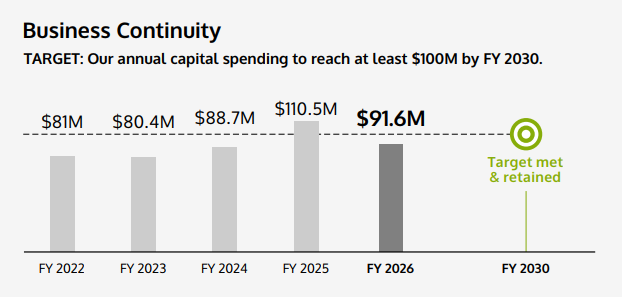
Throughout FY2026, we invested approximately USD 3.3 million in capital improvements to strengthen our risk management capabilities. These investments supported upgrades to critical fire detection systems, structural improvements, cybersecurity measures, spill containment infrastructure, and emergency interlock systems, among other initiatives.
Specialized risk engineers visit each site twice annually to identify risks to property and ongoing operations. One visit focuses on fire and natural hazards, while the other focuses on critical equipment and machinery. We also work closely with our process technology and corporate engineering functions to coordinate recommendations related to protection of our electrical equipment and machinery to ensure safety and continuous operation.
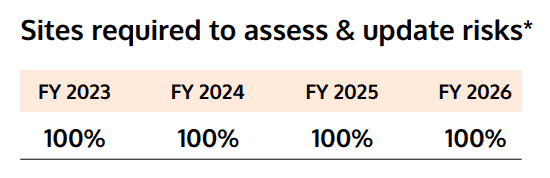
We track the completion of identified risk controls through our risk management information system. All sites are required to review and update their risks annually. The findings help identify and address sites specific risks and inform our Business Continuity Management process. In FY2025, we upgraded our risk management software to fully digitize the Business Continuity Management process. Information on risks, associated controls, and business continuity plans are all managed through a single platform.
Employees are encouraged to report identified risks including near-miss safety incidents, unethical activities, or other observed risky behaviors. These risks are
documented and prioritized through a Risk Register based on the likelihood, volatility, and potential financial impacts. Regional Risk Officers manage the risk registers, with information displayed through heat maps and dashboards for ease of access.
Information Security
Information security is embedded throughout Birla Carbon’s digital transformation journey. Guided by our “Security with Simplicity” philosophy, we
integrate cybersecurity into our technologies and processes from the earliest stages, helping protect critical information assets, reduce cyber risks and ensure the resilience and reliability of our global operations.
Business Ethics and Compliance
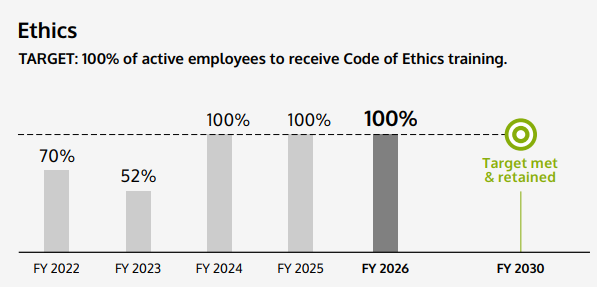
Operating with integrity is fundamental to how we conduct business. Our Code of Ethics provides the framework for ethical decision-making across the organization, covering areas such as human rights, fair competition, anti-corruption, workplace conduct and grievance mechanisms.
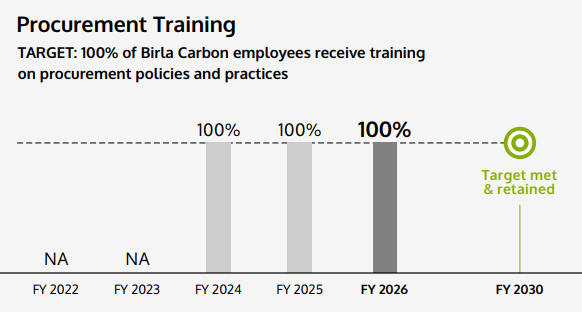
All employees, including members of the Senior Management Team, are required to sign the Code of Ethics and participate in regular ethics and compliance training.
Sustainable Procurement and Supplier Due Diligence
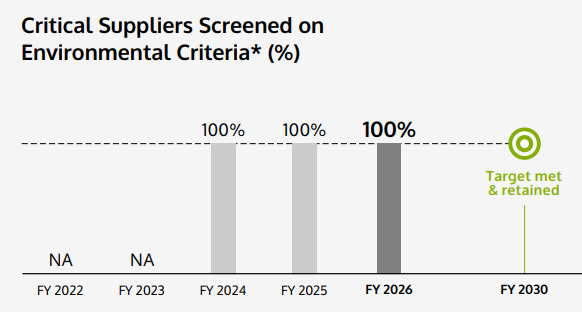
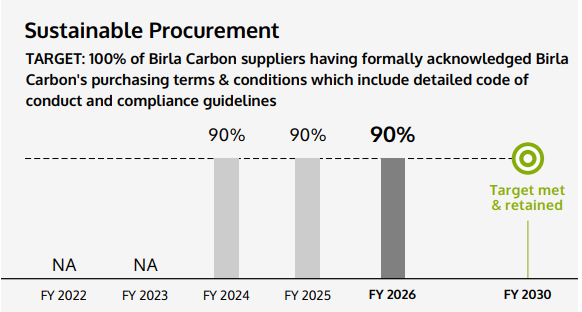
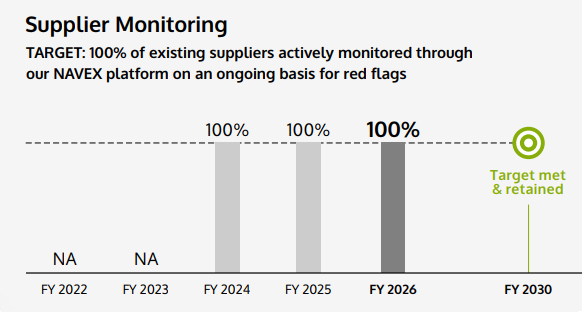
Responsible sourcing is central to our procurement approach. Through our Supply Chain and Procurement Policy, Code of Ethics and Standard Operating Procedures, we establish clear expectations for ethical, compliant and sustainable business practices across our supply chain.
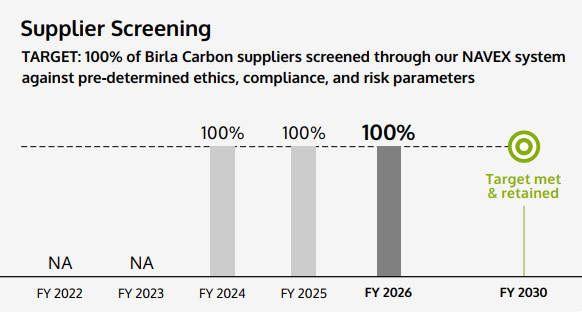
Our supplier due diligence program was launched in 2019 and 100% of our 18,171 active vendors have been screened and continue to be monitored, reinforcing
transparency, accountability and responsible sourcing across our global operations.
Product Responsibility
Product safety, quality and stewardship are fundamental to our approach to responsible manufacturing. Through robust product stewardship standards, rigorous testing protocols and structured quality management systems, we ensure our carbon materials consistently meet customer expectations while supporting their safe and responsible use throughout the value chain.
Our governance framework includes comprehensive testing, product traceability, change management and continuous oversight to maintain product integrity across our global operations.