




Environment
Environmental Stewardship
Environmental stewardship is integral to how we operate and grow. We focus on understanding and managing our environmental impacts across our operations and value chain, while seeking opportunities to use resources more efficiently and create lasting environmental value.
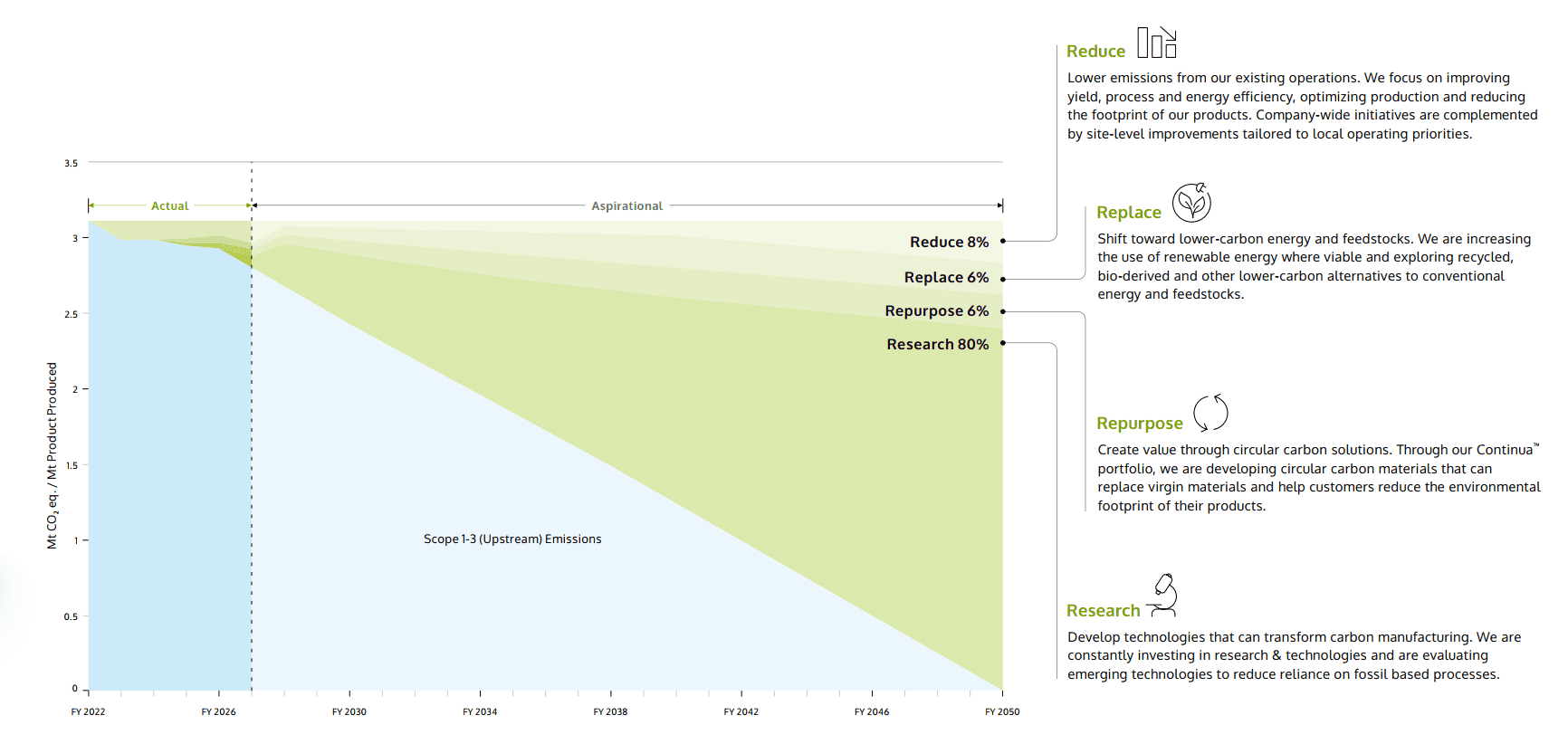
Our Net-Zero Roadmap
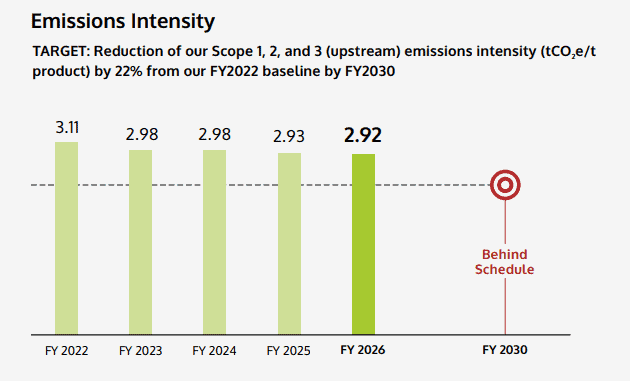
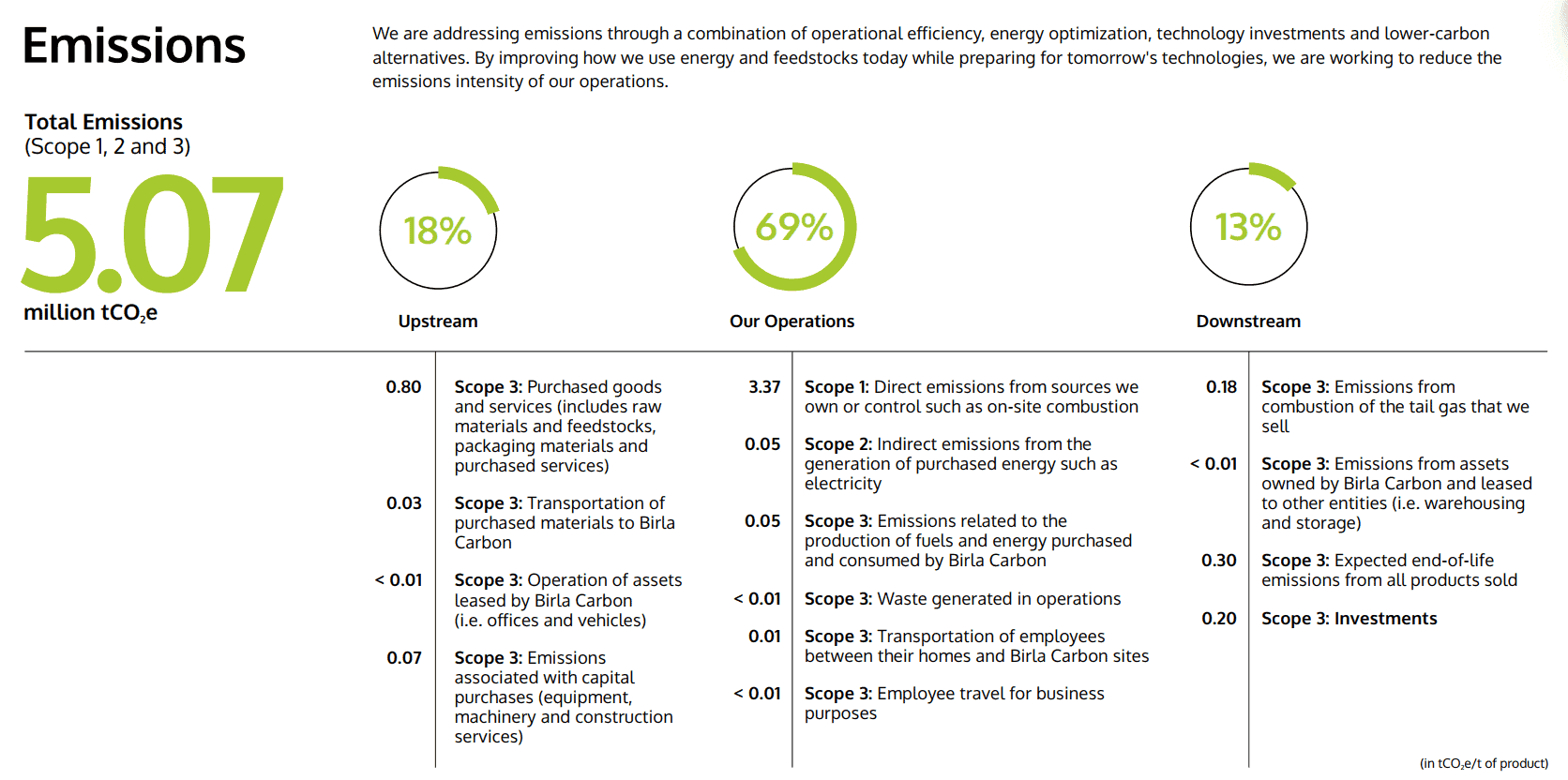
Our net-zero pathway is anchored in four complementary levers: Reduce, Replace, Repurpose and Research. Together, they span near-term operational improvements, the transition to lower-carbon inputs, circular solutions and the development of technologies that can transform carbon manufacturing over the longer term. Enabled by collaboration with industry partners and experts, our commitment is to achieve net-zero carbon emissions by 2050
Waste Heat, Real Impact
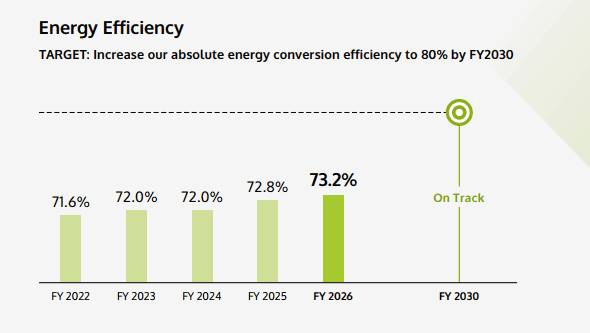
At our Weifang plant in China, optimizing an existing waste-heat recovery system has helped address the challenge of maintaining production during heavy-pollution periods while improving energy efficiency.
During FY2026, the site worked with local partners to optimize steam export and completed targeted equipment upgrades, including a new Co-Gen economizer, soot boiler, variable frequency drive and air-compressor waste-heat recovery system.
The improvements delivered measurable results: energy efficiency increased from 60.3% in FY2023 to 65.5% in FY2026, while recovered heat supplied for residential heating avoided an estimated 20,809 tCO₂e in FY2026, up from 18,758 in FY2025.
The project also enabled zero shutdowns during heavy-pollution days since November 2023, demonstrating how waste-heat recovery can simultaneously support decarbonization, operational resilience and resource efficiency
Leveraging Technology to Manage Air Emissions
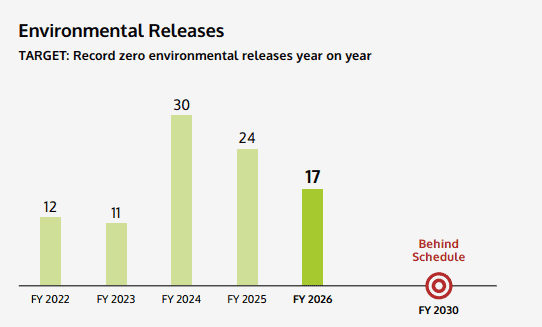
We are also focused on reducing non-GHG air emissions through improved processes and technologies. We closely monitor emissions to maintain compliance with local regulations.
We continue to invest in advanced technologies to reduce air emissions, including state-of-the-art filtration systems for effective containment and recovery of carbon black dust.
At our Thailand facility, we installed emissions control equipment to significantly reduce SOX and NOX emissions. At our Hamilton facility in Canada, a new main baghouse filter is improving the efficiency and reliability of the main production unit. This reduces downtime, enables more efficient use of utilities, and limits the release of particulate matter. In addition, the installation of a more efficient air compressor is reducing dependence on grid electricity and other fossil-based resources. Since FY2022, our seawater scrubber in Louisiana, USA, has also delivered significant SOX reductions.
We recognize that some emissions-control technologies can increase waste generation and we continue to address this as part of our environmental management efforts.
Circularity
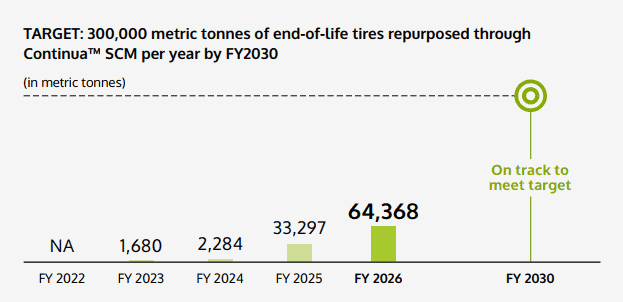
Circularity is central to our approach to reducing reliance on virgin resources and keeping valuable materials in use. Through Continua™ Sustainable Carbonaceous Material (SCM) and Continua™ Sustainable Carbon Black (SCB), we are expanding the use
of circular materials and creating alternatives that can be integrated into products across tires, mechanical rubber goods, plastics and other applications.
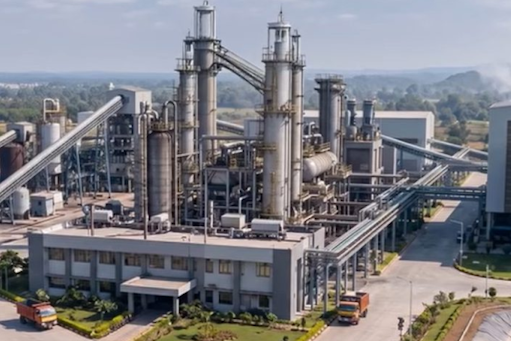
With production established in Italy and India,we are scaling Continua™ SCM and are on track to make more than 100,000 tonnes annually by FY2030. Produced from end-oflife tires, Continua™ SCM helps divert tire waste from landfill while reducing the need for virgin materials.
Our circularity efforts also extend to material already within the value chain. Customers are encouraged to return unused carbon black for reprocessing, while offgrade material is segregated and reprocessed until it meets our quality standards. These practices help maximize resource use and minimize waste
Water
We are proud to report that 100% of our manufacturing sites use recycled process water and/or harvested rainwater in their operations.
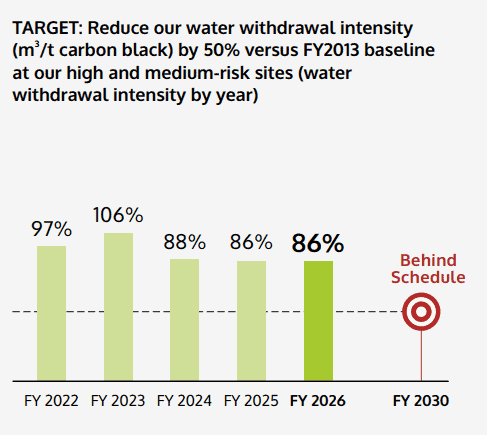 Our approach to water combines conservation, risk assessment and preparedness. We assess water-related
risks across our operations, with particular attention to sites exposed to higher levels of water stress or resource constraints.
Water risk management forms part of our broader Enterprise Risk Management (ERM) framework, with higher-risk sites incorporating Water Resource Management Plans (WRMPs) into their business continuity planning. These plans address both immediate and potential future risks, with mitigation measures reviewed regularly. We also use external tools and partnerships to strengthen our understanding of water risk.
In collaboration with the World Business Council for Sustainable Development (WBCSD) and World Resources Institute (WRI), we assess water stress across our manufacturing footprint using the WRI Aqueduct tool and share waterconservation practices across our locations.
Our Water Stewardship Policy sets the governance framework for protecting and conserving water resources. Its six-step methodology draws on the European Water Stewardship (EWS) Standard, Alliance for Water Stewardship (AWS) Standard and ABG Technical Standard on water management.
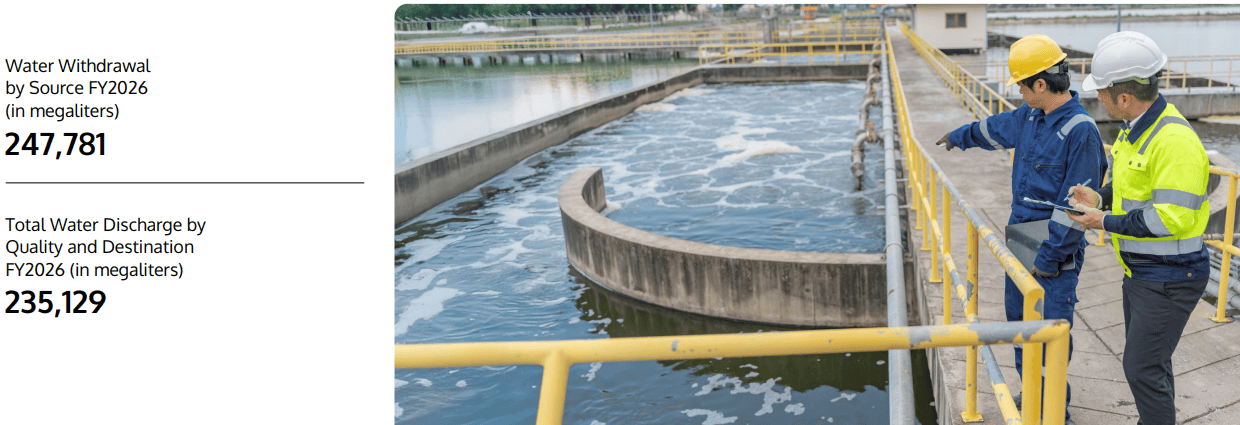
Rethinking Water Use Through 3Rs
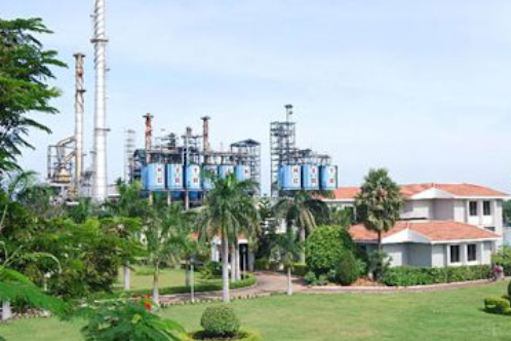
Water scarcity posed growing operational risks at our Gummidipoondi plant, which is located in a water-stressed region in India. Birla Carbon responded with an integrated Reduce, Reuse and Recycle (3R) approach, treating and reusing water from filter backwash, RO reject, equipment and road washing, cooling-tower blowdown, sewage and other streams.
These measures reduced the water consumption intensity by 0.414 m³ per tonne of carbon black and the freshwater intake by 173,000 m³ over the last two years. The approach also strengthened resilience to seasonal water shortages and provides a practical model that can be replicated across other facilities.
Modernizing Water Efficiency
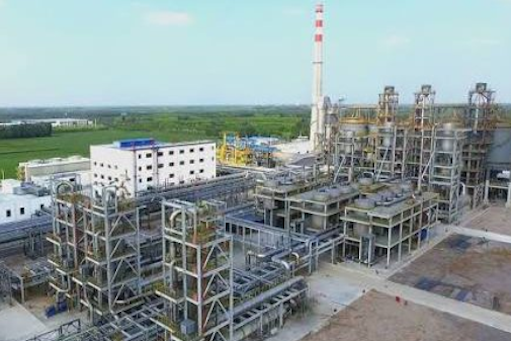
At our Hickok plant in the USA, the aging reverse osmosis (RO) system had become increasingly inefficient. It operated at 78% efficiency with an 18.2% rejection rate, resulting in significant water loss and higher operating costs. We replaced the system with a higher-efficiency RO unit and variable-frequency drive (VFD) pumps. The upgrade also included modifications to the supporting infrastructure to maintain production during installation.
The project is expected to save approximately 2 million gallons of water annually and 257 thousand kWh of electricity, while reducing wastewater sent to evaporation ponds. The closed-circuit RO configuration can be scaled across other facilities.
Water-free
Cooling
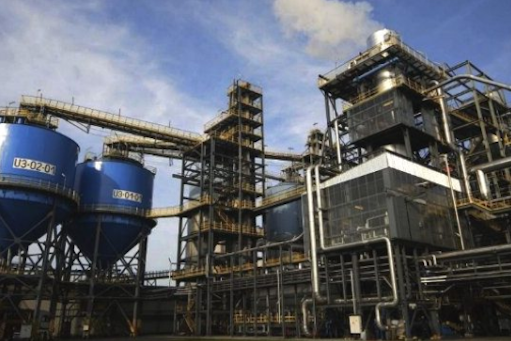
At the Thailand and India greenfield facilities, Birla Carbon designed the plants to have the air-cooled condenser (ACC) technology instead of conventional water cooled condensation incorporating water efficiency into plant design from the outset. The solution virtually eliminates
freshwater use for steam condensation, removes cooling-tower blowdown and associated chemical use, strengthening resilience in water-stressed regions.
Based on design data, the projects are expected to avoid approximately 3 million m³ of freshwater use annually. The approach also provides a scalable model for integrating water-efficient cooling into future facilities.
Waste
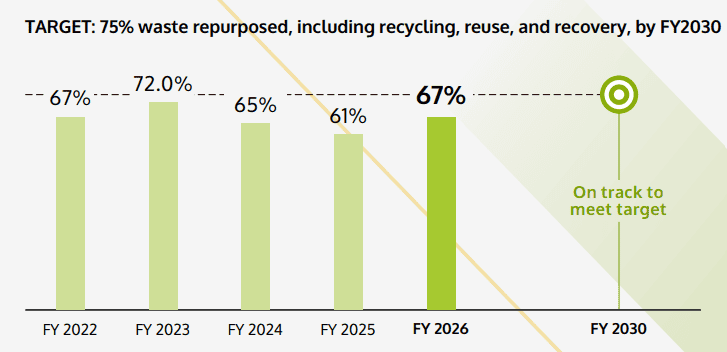
Management and minimization of waste is a priority for all Birla Carbon manufacturing sites and offices.
Our approach focuses first on preventing waste, followed by reuse and recycling wherever it is feasible. We continue to strengthen waste identification and accounting, while encouraging sites to adopt new approaches and practices that reduce waste generation. Our Waste Management Standard sets requirements for the accounting, handling, storage, transportation and safe disposal of solid and hazardous waste, in line with applicable HSE requirements.
Product Sustainability Portfolio
Birla Carbon’s portfolio spans conventional carbon black, circular carbon materials and advanced carbon-based solutions. Together,
these products support performance across tires, rubber, plastics, coatings, inks, adhesives and energy systems.
Life Cycle Assessment (LCA) of our products provides a science-based understanding of their environmental footprint, informing product and process decisions and providing customers with credible data to support their sustainability and decarbonization efforts.
Carbon Black
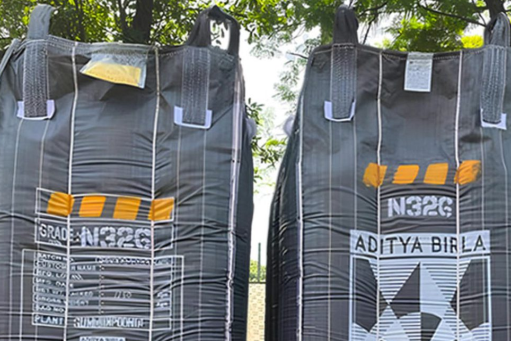
Carbon black remains the core of our product portfolio. Its reinforcing, conductive, pigmentation and other functional properties support a wide range of applications, including tires, mechanical rubber goods, plastics, coatings and inks.
Product Carbon Footprint: Our FY2024 cradle-to-gate LCA, conducted i accordance with ISO 14040 and ISO 14044 and independently verified, places Birla Carbon’s global carbon black footprint at 2.77 kg CO2e per kg of carbon black. The assessment provides a science-based basis for identifying reduction opportunities and supporting customers in understanding their value-chain emissions.
Continua™ Sustainable Carbonaceous Material (SCM)
Continua™ SCM is a circular material derived from the pyrolysis of end-of-life tires. It provides an alternative to conventional carbon black across applications including tires, mechanical rubber goods, plastics and coatings, enabling customers to incorporate recycled content while reducing product carbon footprints.
Life Cycle Assessment: Our LCA indicates that Continua™ 8000 SCM offsets approximately 0.73 kg CO₂e for every kg produced, based on a system expansion approach. At full capacity, it has the potential to eliminate more than 220,000 tonnes of CO₂ emissions annually compared with conventional carbon black.
Continua™ Sustainable Carbon Black (SCB)
We continue to conduct production trials utilizing recycled and bio-derived feedstocks to produce Sustainable Carbon Blacks (SCB). These trials proved our ability to produce high-quality ASTM and non-ASTM grades of carbon black with these alternative feedstocks. As we increase our SCB production capabilities over the coming year, we will conduct an LCA to understand the carbon footprint of SCBs, and we will focus on the safe and sustainable procurement of these innovative raw materials.
Life Cycle Assessment: As we are conducting trials with innovative feedstocks at different geographical locations, the emissions factors for these feedstocks are
not consistent. Since we are not vertically integrated, significant effort is required to bridge the gaps of lack of primary data and inclusion of spatial variabilities. Since the origin of these sustainable feedstocks may cross different types of supply chain, it also incorporates different LCA rules on allocation and assigned emission factor values. In addition to that, these categorizations also vary based on geographical locations.
As we progress and have more data available and minimize the data gap, we will have more accurate representation of our carbon footprint for these products.

Nanocyl™ Carbon Nanotubes
Nanocyl™ expands our portfolio into multiwalled carbon nanotubes (MWCNTs), with applications across energy storage, automotive, electronics and industrial markets. Their electrical conductivity and mechanical properties enable material solutions that use lower loadings and support applications such as lithium-ion batteries, conductive polymers and lightweight composites.
Life Cycle Assessment: Our FY2026 cradleto-gate LCA indicates a carbon footprint of 20.13 kg CO₂e per kg of CNT. A first in the industry, the LCA was conducted in accordance with ISO 14067 and is conformant with ISO 14071 meaning the methodology and the results were independently verified by a third-party verifier. Primary data for the assessment was obtained directly from the Nanocyl™ manufacturing plant.