




Nanocyl Expertise Center
Technology
Carbon nanotubes are cylindrical particles made of carbon atoms covalently bonded in hexagonal shapes. Carbon nanotubes diameters can be as small as 1 nanometer and their length up to several centimeters. When composed of multiple concentric cylinders of carbon atoms, they are called multiwall carbon nanotubes. If made of only one cylindrical wall, they are called singlewall carbon nanotubes.
A carbon nanotube (CNT) is a tube-shaped material, exclusively composed of carbon atoms, having a nanometric diameter. A nanometer is one billionth of a meter, or about one ten-thousandth of the thickness of a human hair. The graphite layer can be visualized somewhat like a rolled-up chicken wire with a continuous unbroken hexagonal mesh and carbon atoms at the apexes of the hexagons. With action of van der Waals forces, CNTs have a tendency to cluster into bundles or agglomerates. Consequently, commercially available CNTs look like a black powder (macro scale).
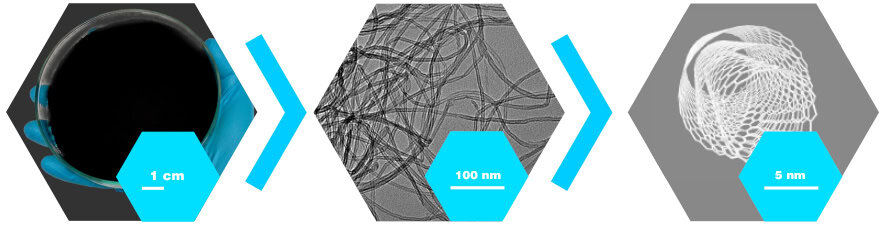
Figure 1: NC7000™ multiwall carbon nanotubes. From left to right: macro scale, microscopic scale, nanoscale.
CNTs exist in many structures, differing in length, diameter, helicity type and number of walls. Their electrical characteristics differ depending on these variations, acting either as metals or as semiconductors.
Carbon nanotubes are classified in two main groups:
- Singlewall carbon nanotubes (SWCNTs). The structure of a SWCNT can be visualized as a single layer of graphite (i.e. graphene) which is rolled into a seamless cylinder. SWCNT has one single cylindrical wall. SWCNTs diameters are in average from 1 to 5 nm and length superior to a few µm.
- Multiwall carbon nanotubes (MWCNTs). MWCNTs can be visualized in the form of a coaxial assembly of imbricated SWCNTs. The MWCNTs’ diameters are typically in the range of 5 nm to 50 nm and length from µm to cm.
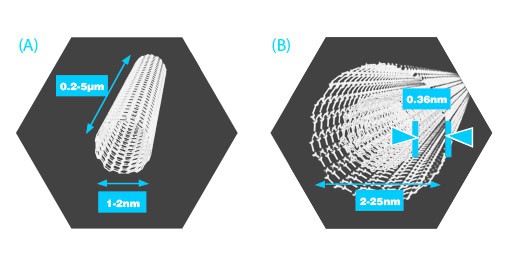
Figure 2: (A) Nanometric illustration of SWCNT; (B) Nanometric illustration of MWCNT.
MWCNTs are easier to manufacture at industrial scale compared to SWCNTs. MWCNTs structure exhibits greater complexity and variety. The challenge in producing SWCNTs in metric tons as compared to MWCNTs is reflected in the SWCNT price, which currently remains 100 fold higher than MWCNT.
MWCNTs present therefore a higher performance/cost ratio compared to SWCNTs.
Check detailed case studies or references in Expertise Center.
A carbon nanotube is an outstanding material with intrinsic transport and mechanical properties. At the particle level, it is as electrically conductive as copper, five times stronger than steel, more thermally conductive than diamond and has a low density. Those intrinsic properties make them accurate product for nanoelectronic devices.
 |
Five times stronger than steel |
 |
As electrical conductive as copper |
 |
1.5 times more thermal conductive than diamond |
Table 1 shows that CNTs present a unique combination of low density (lightweight material), stiffness (young modulus, E), tensile strength and tenacity compared to other fiber materials which usually lack one or more of these properties.
Table 1. Mechanical properties of industrial engineering fibers
| Fiber material | Young modulus, E [TPa] | Tensile strength [GPa] | Strain at break [%] | Density [g/cm³] |
|---|---|---|---|---|
| Carbon nanotube | 1 | 10-60 | 10 | 1.3-2.0 |
| Carbon fiber – PAN | 0.2-0.6 | 1.7-5.0 | 0.3-2.4 | 1.7-2.0 |
| Carbon fiber – Pitch | 0.40-0.96 | 2.2-3.3 | 0.27-0.60 | 2.0-2.2 |
| High Speed Steels fiber | 0.2 | 4.1 | <10 | 7.8 |
| Dupont® Kevlar 49 | 0.13 | 3.6-4.1 | 2.8 | 1.4 |
| E or S glass fiber | 0.07-0.08 | 2.4-4.5 | 4.8 | 2.5 |
Table 2 shows that CNT present a unique combination of low density (lightweight material), very high current density and high electrical conductivity.
Table 2. Electrical Properties of Industrial Conductive Materials
| Fiber material | Electrical resistivity [Ω.m] | Max current density [A/m²] | Density [g/cm³] |
|---|---|---|---|
| Carbon nanotube alone | 10–⁸ | 10ⁱⁱ | 1.3-2.0 |
| Carbon nanotubes fibers | 10–⁷ | 10⁵ | 1.3-2.0 |
| Copper | 1.7×10–⁸ | 10⁷ | 8.9 |
| Aluminum | 2.7×10–⁸ | 10⁸ | 2.7 |
Table 3 shows that CNT present a unique combination of low density (lightweight material), very high thermal conductivity.
Table 3. Thermal properties of industrial conductive materials
| Fiber material | Thermal conductivity [W/mK] | Density [g/cm³] |
|---|---|---|
| Carbon nanotube | up to 6000 | 1.3-2.0 |
| Diamond | 3320 | 3.5 |
| Carbon fiber – Pitch | 1000 | 2.0-2.2 |
| Copper | 400 | 8.9 |
| Aluminum | 237 | 2.7 |
Intrinsic properties of carbon nanotubes make them ideal for nanoelectronic devices.
In pratical terms, the van der Waals forces lead the carbon nanotubes to appear in µ-meter sized agglomerates because carbon nanotubes have a strong tendency to stick together. In order to avail their properties to the host matrices (thermoplastics, elastomers, water, etc.), carbon nanotubes need to be adequately disentangled/dispersed during processing. The optimum disentanglement/dispersion of carbon nanotubes is a key element to reach high performance nanocomposites.
Carbon nanotubes are ideal multifunctional carbon additives to improve materials performances.
Carbon nanotubes (CNTs) agglomerates in powder form are rarely used as such except for specific applications such as filtration systems or sensors.
They are generally embedded in a matrix and will partially transfer their outstanding properties to the host matrix. The matrix could be any material such as a thermoplastic, rubber, water, metal, ceramic and so on. CNTs appear in µ-meter sized agglomerates because carbon nanotubes have a strong tendency to stick together due to van der Waals forces. CNTs need to be disentangled to improve specific properties of the host matrix. Dispersion equipment used will depend on the host matrix. The optimum dispersion of CNTs is a key element to reach high performance nanocomposites.
CNTs improve specific properties of the host matrix (e.g. electrical conductivity) with a lesser impact on other properties (e.g. mechanical properties) than other carbon fillers due to much lower loading required. Carbon nanotubes are ideal multifunctional carbon additives to improve materials performances compared to chopped carbon fibers (cCF), carbon blacks (CB), graphite or carbon nanofibers (CNF).
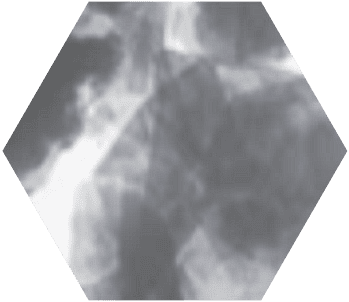
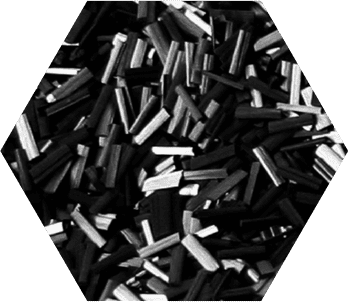
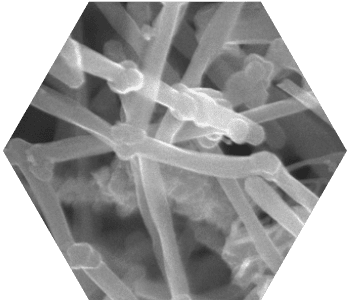
Table 4. Carbon fillers properties. From top to bottom: Super P®Li CB, Timerex® KS6 Graphite, Tenax® cCF, VGCF™ CNF, NC7000™ CNT.

- Diameter (nm) : 40
- Aspect ratio : 1:1
- Specific surface area (m²/g) : 60-80
- Volume resistivity (Ω.cm) : 10-2
- Thermal conductivity (W/mK) : <200
- Tensile strength (GPa) : <0.4
- Diameter (nm) : 3000-5000
- Aspect ratio : 1:1
- Specific surface area (m²/g) : 10-20
- Volume resistivity (Ω.cm) : 10-4
- Thermal conductivity (W/mK) : <600
- Tensile strength (GPa) : <0.4
- Diameter (nm) : 106
- Aspect ratio : 1:6
- Specific surface area (m²/g) : 20
- Volume resistivity (Ω.cm) : 10-3
- Thermal conductivity (W/mK) : 20 (axial)
- Tensile strength (GPa) : 3.8
- Diameter (nm) : 150
- Aspect ratio : 10-100:1
- Specific surface area (m²/g) : 13
- Volume resistivity (Ω.cm) : 10-4
- Thermal conductivity (W/mK) : 1200
- Tensile strength (GPa) : <10
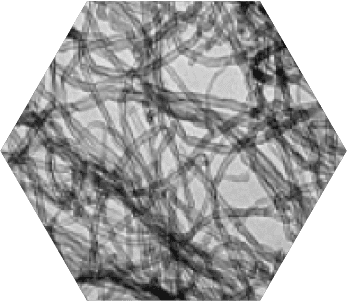
- Diameter (nm) : 9.5
- Aspect ratio : 100-1000:1
- Specific surface area (m²/g) : 250-300
- Volume resistivity (Ω.cm) : 10-4
- Thermal conductivity (W/mK) : >3000
- Tensile strength (GPa) : 10-60
Graphene nanoplatelets and SWCNTs are not available at the industrial scale. Performance results integrated in host matrices are currently demonstrated only at lab scale.
Figure 1 demonstrates the low electrical conductivity percolation threshold of carbon nanotubes compared to other carbon conductive additives.
Figure 1. Surface resistivity of carbon-filled polycarbonate compounds. Source: Nanocyl conductivity measurements.
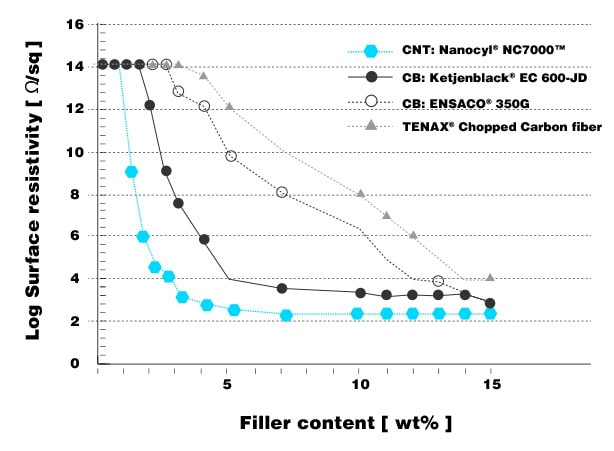
Carbon nanofibers (CNF) and high conductive expanded graphite are not present in the graph because they are used in specific applications.
Here below is a brief description of the properties improved by carbon nanotubes. Those statements are strongly dependent on the dispersion processes, the type of polymer and even often on the polymer grade.
In thermoplastics, CNTs bring electrical conductivity with a low percolation threshold (between 0.5 wt% and 4.5 wt% depending on the thermoplastic and the dispersion processes). In general, CNTs are more easily dispersed in polar thermoplastics. The main advantage of CNTs is that they affect less the mechanical properties (e.g. elongation at break) than other conductive fillers such as carbon blacks or graphite. This is due to the high aspect ratio of CNTs resulting in a very low amount of CNTs needed to reach a specific conductivity. CNTs increase more the viscosity than CB at equal loading, but the much lower quantities of CNTs required render the processing better in most cases or comparable. CNTs concentration below 1 wt% in thermoplastics improves elongation at break and impact resistance without affecting tensile strength and keeping the thermoplastics electrically insulating. CNTs in thermoplastics offer additional improvement in cleanliness, thermal dissipation, recyclability, flame retardancy, black tinting and UV resistance.
In elastomers, CNTs improve electrical conductivity with a low percolation threshold (between 1 and 4 phr depending on the elastomer and the dispersion processes). CNTs have a stronger reinforcing factor than any other additives such as carbon blacks and silicas. Nevertheless, a synergetic effect between CNT and carbon blacks is generally observed. The combination of CNTs and carbon blacks simultaneously improves tensile strength and elongation at break compared to raw elastomers. In general, CNT/CB elastomers present higher abrasion resistance, higher thermal dissipation and good chemical resistance resulting in extended lifetime and contributing to the development of more durable products. CNT/cast PU composites generate no skid marks. CNT/silicones coatings present a nanostructured surface conducting to a fouling release effect.
In epoxy and acrylic resins, CNTs improve electrical conductivity with a low percolation threshold. In carbon or glass fiber reinforced polymers, while the planar conductivity is brought by PAN or pitch carbon fibers, CNTs strongly increase the through thickness conductivity (z-axis) protecting structural composites from delamination due to lightning strikes.
Carbon nanotubes in those resins generally increase crack resistance. In carbon or glass fiber reinforced polymers, grinded carbon nanotubes/thermoplastics added between the PAN carbon fibers layers increase compression after impact.
In water and solvents, carbon nanotubes bring electrical and thermal properties. Coatings containing such CNT dispersions have improved electrical, thermal and crack resistance/propagation properties.
In metals and ceramics, carbon nanotubes improve thermal and mechanical properties.
Check detailed technical case studies available in Expertise Center.
Check also the different families of formulated products in the Section Products.
Nanocomposites containing carbon nanotubes push materials to new limits of performances allowing more sustainable solutions to emerge in different markets: transportation (automobile, aeronautics, maritime), energy (lithium-ion batteries, flow batteries and super-capacitors), electronics (electronic packaging, EMI shielding), sport goods and industrial solutions. This is a non-exhaustive list of markets since new applications are regularly discovered.

Carbon nanotubes (CNTs) improve different properties in a large variety of materials which are themselves used in a large set of applications, such as:
- Conductive plastics to improve safety in transport market, recyclability and cleanliness in electronics market
- High performance carbon or glass fibers reinforced polymers in automotive, aeronautics and sport goods markets
- Improved rubbers for time and conveyor belts
- Fouling release marine coatings
- Lithium-ion batteries with improved lifetime
- Nanosensors to detect harmful gases
- Flexible heating elements
- EMI shielding
- Corrosion protection coatings
- Super-capacitors
- Organic light-emitting transistors for large flat-panel displays
- Water filters
- Flexible thermoelectric or piezoelectric devices
- Heat exchangers
- Extra strong fibers
Check detailed technical case studies or references in Expertise Center.
Catalytic Chemical Vapor Deposition (CCVD) method is the main current method allowing an industrial scale production of carbon nanotubes with high purity.
- Arc discharge method. This method creates CNT through arc-vaporization of two carbon rods placed end to end, separated by approximately 1 mm, in an enclosure that is usually filled with inert gas at low pressure.
- Laser vaporization method. In this method, CNTs are prepared by laser vaporization of graphite rods with a 50:50 catalyst mixture of cobalt and nickel at 1200°C in flowing argon, followed by heat treatment in a vacuum at 1000°C to remove the C60 and other fullerenes.
- Catalytic Chemical Vapor Deposition (CCVD) method. The process illustrated in the Figure 1 consists in the decomposition of a hydrocarbon vapor into carbon and hydrogen on a catalytic surface at high temperature (600-1200°C).
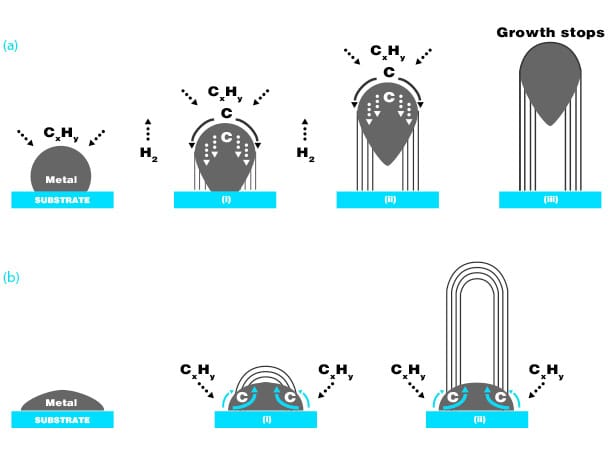
Figure 1. Widely-accepted growth mechanisms for MWCNT in CCVD process with a catalyst composed of a metallic particle and a support: (a) tip-growth model, (b) base-growth model.
Arc discharge and laser vaporization are currently the principal methods for obtaining small quantities of high quality CNTs (high crystallinity). However, both methods suffer from drawbacks. First, they involve the evaporation of the carbon source, hence complicating the upscaling of the production (yield issue). Second these vaporization methods grow CNTs in highly tangled forms, mixed with unwanted forms of carbon and/or metal species. The CNTs thus produced are difficult to purify, handle, and assemble to build nanotube-device architectures for practical applications (purity issues).
In other words, Catalytic Chemical Vapor Deposition method is the main current method allowing an industrial scale production of carbon nanotubes with high purity.
Health, Safety & Environment
From NANO to MWCNT
Many countries and organizations have developed working definitions to identify nanomaterials based on the size of the material, its novel properties, or a combination of both. In fact, each material “exists” at the nanoscale. Materials at nanoscale behave differently than those at macroscale. Nanoparticles present incredible properties based on “quantum effects” and other simple physical effects such as expanded surface area. In summary, “nano” is just a question of size and not of material or composition.
Nanoscience and nanotechnology are the study and application of extremely small things and can be used across all the other science fields, such as chemistry, biology, physics, materials science, and engineering. In the International System of Units, the prefix “nano” means one billionth, (or 10-9) of a meter. The Figure 1 illustrates clearly the nanoscale.
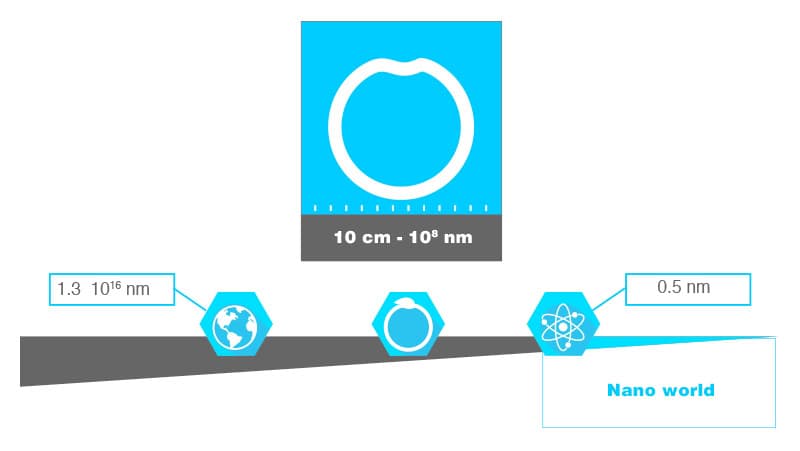
Figure 1. The « Nano » scale.
Nanoparticles are abundant in nature, as they are produced in many natural processes, including photochemical reactions, volcanic eruptions, forest fires, simple erosion and by plants and animals. Any groups of atoms or molecules present in nature have a “nano” size such as amino acids, proteins, DNA, viruses, etc. Those are organic molecules with carbon atoms, hydrogen atoms and oxygen atoms mainly.
In fact, each material “exists” at the nanoscale. During a long time, humans have not been able to produce with a sufficient control material at nanoscale such as nature is doing since millions of years. Other sources of nanoparticles can be identified and originates from the man-made activity such as incidental nanoparticles generated as unwanted by-products from combustion processes (e.g.: charcoal burning, incinerators,…).
Materials at nanoscale behave differently than at macroscale and nanoparticles often presents incredible properties based on “quantum effects” and other simple physical effects such as expanded surface area. The integration of the nanoparticles inside a matrix leads to improve specific properties depending on the nature of the nanoparticles and the matrix in which the nanoparticles are integrated (polycarbonates, polystyrene, polyethylene, natural rubber, polyurethane, epoxies, etc.). Each type of nanoparticle will improve a different set of properties (electrical, mechanical, thermal, etc.).
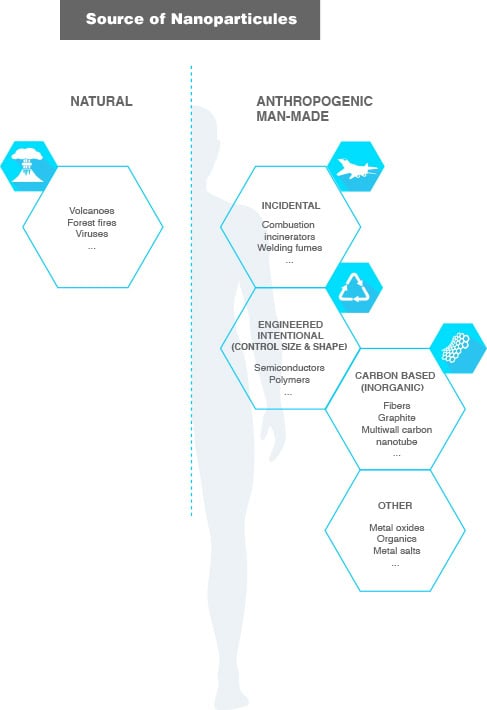
Figure 2. Sources of nanoparticles.
In summary, “nano” is just a question of size and not of material or composition.
The definition of a nanomaterial does not make the consensus yet. In 2011, the European Commission adopted a recommendation on the definition of a nanomaterial in 3 steps [COMMISSION RECOMMENDATION of 18 October 2011 on the definition of nanomaterial(Text with EEA relevance) (2011/696/EU)]:
- a natural, incidental or manufactured material
- That contains particles, in an unbound state or as an aggregate or as an agglomerate
- and where, for 50% or more of the particles in the number size distribution, one or more external dimensions is in the size range 1 nm – 100 nm.”
It is finally quite recently that humans have developed techniques for manufacturing nanoparticles in a controllable and reproducible way; what are called today engineered nanoparticles (“ENP”).
Figure 3 illustrates that nanoparticles look very different. Spheres, rods, fibers, stars, cups,… are various shapes that have been identified.
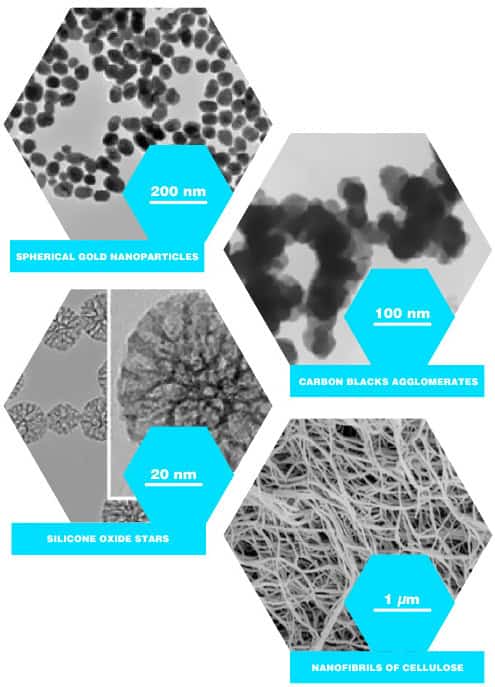
Figure 3. Different material shapes at the nanoscale. From left to right: spherical gold nanoparticles, carbon blacks agglomerates, silicone oxide stars, nanofibrils of cellulose.
Various carbon structures exist at the nanoscale with different properties and costs. 3D carbon atoms layout could lead to various structures such as diamond, graphite (several hundreds of layers of graphenes), carbon blacks, tubular carbon nanotubes, graphene layer (1D material), fullerene (ball structure), carbon fibers etc.
The Figure 4 presents different carbon materials at the nanoscale. Those materials are only composed of carbon atoms but their primary structure is very different.
3D carbon atoms layout could lead to various structures such as nanodiamond, graphite (several hundreds of layers of graphene), carbon blacks, tubular carbon nanotubes, graphene layer (1D material), fullerene, carbon fibers etc.
 Nanodiamond
 Fullerene C60
 SWNT
SWNT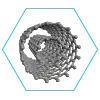 MWNT
MWNT Graphene
Figure 4. Main carbon allotropes.
Source: “Environmental Applications of Carbon-Based Nanomaterials”, Environmental Science & Technology, 42, 5843 (2008)
Those primary structures represent the different possibilities of perfect carbon atoms layout. In reality, carbon allotropes contain defects and agglomerates of carbon allotropes slighty differ from their primary structure. Carbon black agglomerates have various complex and stochastic 3D structures. NC7000™ multiwall carbon nanotube (MWCNT) agglomerates have a spaghetti-like structure.
Depending on the manufacturing parameters and processes, a large variety of multiwall carbon nanotube (MWCNT) structures can be produced. Those structures differ in term of size/shape, surface chemistry or purity levels.
In conclusion, multiwall carbon nanotubes toxicological profiles (hazard) have to be assessed on case by case basis. Therefore, results of toxicological profiles (hazard) assessment achieved with NC7000™ cannot be extrapolated for other multiwall carbon nanotubes.
Depending on the manufacturing parameters and processes, a large variety of multiwall carbon nanotubes structures can be produced. Those structures differ in the following parameters:
- Size and shape: Length, diameter, state of aggregates/agglomerates, number of walls, flexibility…
- Surface chemistry: functionnalization, capped or uncapped…
- Purity level: metallic contaminants, molecules adsorbed onto the particle…
Concerns have been raised about a similarity between MWCNTs and asbestos. MWCNTs form a large family of products differing in terms of structure, length, shape, diameter, state of agglomeration.
Figure 5 illustrates the variety of multiwall carbon nanotubes and compares them to asbestos. Asbestos fibers are very sharp long fibers. Long and straight MWCNTs look like asbestos and has raised health questions (Mitsui MWNT-7). However, a vast majority of commercial MWCNTS are curvy/curled, entangled and short and do not show asbestos like forms. In fact NC7000 and hyperion fibrils are representative of this class of not-asbestos like materials.
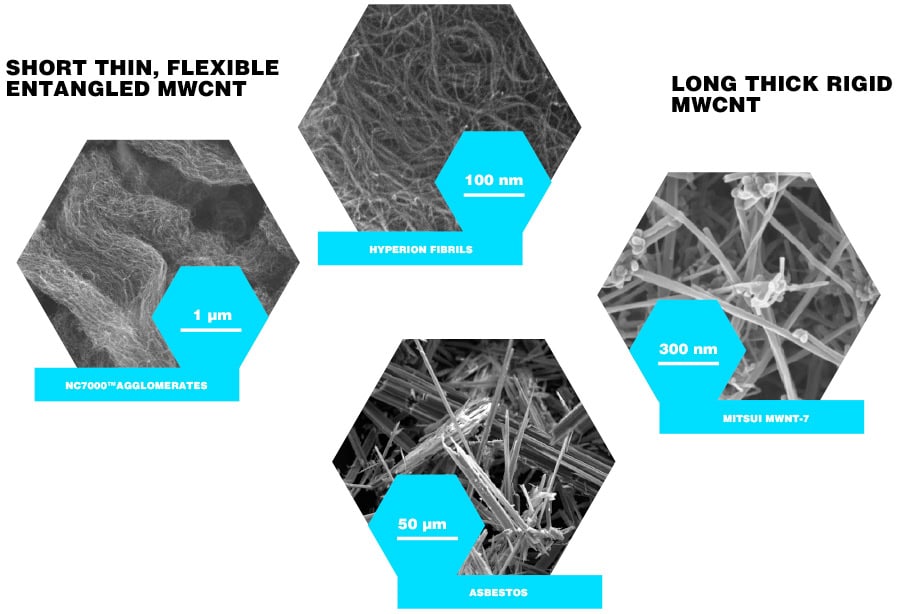
Figure 5. Variety of multiwall carbon nanotubes structures. NC7000™ MWCNT agglomerates, Hyperion fibrils MWCNT agglomerates, Mitsui MWCNT-7 MWCNT and Asbestos.
In conclusion, multiwall carbon nanotubes are extremely various materials and their toxicological profiles (hazard) have to be assessed on case by case basis. Therefore, results of toxicological profiles (hazard) assessment achieved with NC7000™ cannot be extrapolated for other multiwall carbon nanotubes.
Create Safety Expertise
Nanocyl invest substantially into MWCNT (NC7000™) research to demonstrate to the industry and the authorities a clear and objective benefit/risk situation. To this date, internal and external analysis and studies confirm the safety of using NC7000™ in commercially active applications.
Nanocyl is continuously engaging resources to develop knowledge & data building blocks. Over the years, we demonstrated the expertise required to manage the HSE points related to NC7000™ technologies.
We are a responsible company leading pro-actively HSE data generation and assessment:
- Develop and establish validated and reliable scientific testing methods as well as exposure assessment methodology applicable along the product value chain (check our partnerships);
- Associated to the design and the publication of scientific studies,
- Broadening the knowledge and understanding of NC7000™ MWCNT benefits and risks among non-expert audiences;
- Communicating with interested partners worldwide,
- Supporting the “Responsible Care” commitment of the chemical industry.

Nanocyl is committed to the generation of knowledge to ensure that NC7000™ formulated products are safe along the product value chain.
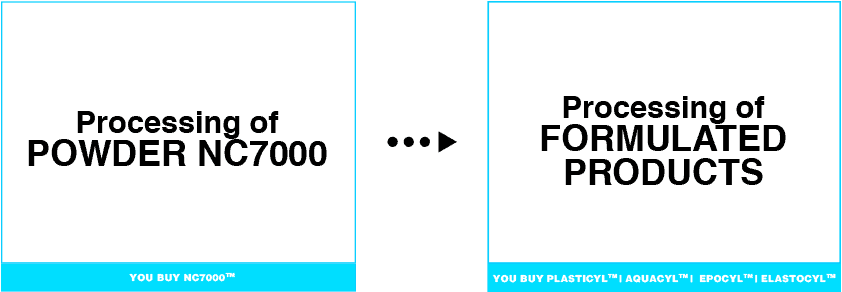
The risk related to the use of NC7000™ powder is not the same as the risk related to the use of NC7000™ integrated in a host matrix.
In order to make the risk assessment of their products, Nanocyl generates data continuously to identify potential issues at different stages of the production, use, and disposal of current and novel applications. The safety recommendations are afterwards, adapted accordingly.
The risk assessment combines the identification of potential hazard of a material with the evaluation of its exposure to humans or environment under real life conditions.
The industrial highest likelihood to release of NC7000™ dust is during the manufacturing and the handling of NC7000™ powder at industrial plants. However, this corresponds to situation in which exposure can be best controlled. Afterwards, NC7000™ powder is incorporated in different matrices either by Nanocyl or by professional compounders. Those NC7000™ formulated products in a host matrix such as thermoplastics, rubbers, etc. will be converted into articles/parts by materials converters such as injection molders, etc. those parts will be integrated into a larger system. The final system is then distributed to consumers in various industries.
Risks will be therefore different if you are in contact with powder or formulated products.
Available data generated on NC7000™ powder according to recognized standards showed no indications of a harmful effect from exposure under real-life conditions.
This statement of the global risk assessment of NC7000™ powder is based on the data generated in hazard and exposure studies (details are available here under).
From those studies, Nanocyl has put in place safe handling recommendations for the use of powder. This is particularly interesting internally and for other companies integrating NC7000™ powder into another material such as compounders.
From exposure under real-life conditions of NC7000™ use, no indications of a harmful effect have been demonstrated:
- Based on hazard assessment on NC7000™, it has been possible to conclude that hazard of NC7000™ is similar to any industrial insoluble particles inducing transient pulmonary inflammation at high doses
- Exposure is likely to be micro-sized aggregates/agglomerates of NC7000™ and not free isolated NC7000™
Hazard of NC7000™ powder
For the time being a case-by-case approach is still appropriate and the hazard assessment described in this section is based solely on the information collected with NC7000™.
Although a large number of studies on the toxicity of MWCNTs have been published in scientific peer-reviewed literature, a clear characterization of the test materials (including sample preparation essential to ensure reproducibility and reliability in the toxicity test using suspension in vivo and in vitro methods), is often missing. Importantly, modifications of some specific characteristics of the MWCNT tested such as variations in size and shape, surface chemistry or purity levels might give rise to differences in the (eco) toxicological profile.
That means, on the other hand, that the values used for any risk assessment should not be associated to all MWCNTs or for CNTs in general. The results obtained with one particular type of MWCNT may not necessarily be relevant for other CNT with other dimensions and properties.
NC7000™ case: In compliance with generally accepted OECD guidelines, tests were conducted on intake and absorption via the mouth, skin and respiratory passages. The studies found no indications of a harmful effect from potential exposure under realistic industrial conditions. A long-term inhalation study similarly showed no indications of a harmful effect on health outside the respiratory passages. The effects observed in the lungs correspond to those typically described for insoluble particles meaning a local transient pulmonary inflammation at sites of predominant deposition for high dose exposure (Ma-Hock et al. 2009, Treumann et al. 2013]). From this study, an internal limit value of 2.5 µg/m3 was derived for workers exposure. Above and beyond the workplace limit value, comprehensive safety requirements are imposed on the manufacturing process.
Figure 6 summarizes the toxicological information generated on NC7000™ after dermal, oral or inhalation exposure. In parallel, ecotoxicological data (OECD 201, 202, 204, 211, 212) indicate no specific toxic effects of NC7000™. These results were generated in several recognized research centers either via funded research programs or via Nanocyl own funds.
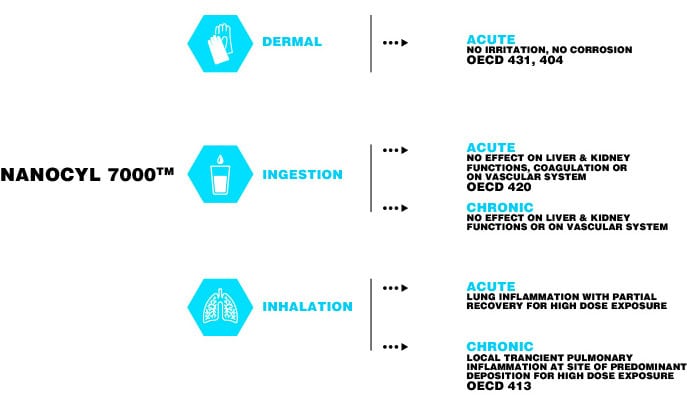
Figure 6. Summary of (eco)toxicological data.
Regarding carcinogenicity of MWCNTs (chronic inhalation effects), different scientific studies propose to consider two main structures of materials:
- Category 1: Short, Thin, Flexible, Entangled (STFE) MWCNT
- Category 2: Long, Thick, Rigid ones (LTR)
The first category of MWCNTs or Short, Thin, Flexible, Entangled (STFE) MWCNTs such as NC7000™, does not behave like asbestos. This has been demonstrated in a 2-years in vivo carcinogenicity study in which rats were intraperitoneally exposed to a single dose of NC7000™ (2 or 20mg/rat) by comparison with asbestos. After 24 months, NC7000™ did not induce mesothelioma in this bioassay. This is contrary to asbestos that induced a clear carcinogenic response (34.6% animals with mesothelioma vs. 3.8% in vehicle controls) (Ref Muller et al, 2009).
The second category is clearly distinct from Category 1 MWCNT. This distinction between Short, Thin, Flexible, Entangled (STFE) MWCNT and Long, Thick, Rigid ones (LTR) was highlighted during the discussions at the International Agency for Research on Cancer (IARC)8. The experts concluded that there is sufficient evidence in experimental animal for the carcinogenicity of the Mitsui-7 MWCNT (second category). This specific Long, Thick and Rigid MWCNT type is now classified in IARC Group 2B like carbon blacks (possibly carcinogen to human).
However, all the other types of CNT (including NC7000™) are classified in the Group 3 (not classifiable as to their Carcinogenicity to Humans). Experts stated that “there is inadequate evidence in experimental animal tests for the carcinogenicity of all the other types of CNT that do not show similar dimensions and shapes to the Mitsui-7 MWCNT”.
Based on those above information, current good practice for the handling of carbon nanotubes is recommended to minimize potential exposition of workers especially for the exposure by inhalation. Handling guidelines, similar to those applied for any industrial insoluble particles, are sufficient to protect the workers from high dose exposure to NC7000™.
Exposure to NC7000™ powder
The industrial highest likelihood to release NC7000™ dust is during the manufacturing and the handling of NC7000™powder at industrial plants. However, this corresponds to situation in which exposure can be best controlled.
Internal measurement campaigns conducted at Nanocyl confirm that, without taking into account the risk management measures in place, powder handling tasks (e.g. transfer, weighing, bagging, dumping, maintenance of the reactor,…) were associated with higher exposure levels in the production area. However, due to the strong tendency of NC7000™ to agglomerate together (Vander Waals forces), exposure to a free isolated NC7000™ is statistically negligible and was never observed during the plant field measurement campaign.
This is confirmed by a dustiness study conducted with the NC7000™ powder in a clean laboratory atmosphere and showing that the average spherical agglomerate of NC7000™ is 14 µm (EN 15051- Gravimetrical dustiness test-internal report).
It is also important to note that conventional protective devices such as filter media and FFP3 cartridge for respirators reduce the exposure of this kind of aerosol. Overall, due to the strong tendency of NC7000™ to agglomerate in the micrometer range, risk management measures to ensure the safety are similar to those used for typical powders such as silica or carbon black.
Available data showed that converters and consumers can use safely applications based on our formulated products.
This statement of the global risk assessment of Nanocyl® formulated products is based on the data generated in hazard and exposure studies.
From those studies, Nanocyl has put in place safe handling recommendations for the use of formulated products. This is particularly interesting for converters such as injection molders.
Available data showed that converters and consumers can use safely applications based on our formulated products.
- Based on hazard assessment on our formulated products, it has been possible to conclude that no additional toxicity was found with polymeric matrices containing NC7000™ compared to raw polymeric matrices.
- Exposure: Fragments of degraded matrix with embedded or surface network NC7000™ are generated by applying mechanical or ageing stress to a polymeric matrix containing NC7000™. Consumers and converters are therefore not exposed to carbon nanotubes (free or agglomerates).
Hazard of formulated products
During the use of articles made of formulated products containing NC7000™, the host matrix could be degraded (abrasion, weathering, etc.) releasing microsized particles. In any case, NC7000™ apparently remains encapsulated inside the matrixes (see section Exposure of formulated product). Moreover, physiological lung effects of the abraded materials containing or not the NC7000™ (either in vivo or in vitro) were assessed. Results demonstrate that there is no additional lung toxicity with the material containing NC7000™ [Wohlleben et al. 20113; Wohlleben et al. 20134].
In conclusion, hazard of Nanocyl® formulated products such as PLASTICYL™ are only driven by the intrinsic hazard of the matrix. In this example, it will depend on the type of thermoplastics.
Exposure to formulated products
NC7000™ carbon nanotubes are not used as free powders, but are always integrated into another material. One can imagine this as a pigment in a plastic material: it becomes a part of the material and is firmly linked, or “built-in”, to the material itself. According to weathering and abrasion studies conducted on NC7000™ formulated products, the exposure to free isolated NC7000™ can be considered as negligible.
In order to investigate the potential release of free isolated carbon nanotubes from formulated products during their uses, Nanocyl has conducted several abrasion (on PP, TPU, epoxy-resin, PVDF, POM, hardened cement paste, crosslinked PU and NR) and UV-weathering tests (on POM, hardened cement paste, TPU, PC, HDPE, crosslinked PU) on various matrixes containing NC7000™ (Wohlleben et al. 200113/20134).
Basically, results are all in line and reveal that, after abrasion, particle release rate did not vary between formulated products containing NC7000™ and raw host matrix (without CNT). In addition, after abrasion or UV-weathering, no evidence of individual free isolated NC7000™, bundles of NC7000™ or NC7000™ attached to larger particles were observed for all formulated products as shown on the Figure 7. Specifically for the weathering tests, the results do not show any migration of NC7000™ to the surface during ageing and consequently, free isolated CNT are not expected to be released from the matrixes. In any case, NC7000™ apparently remain encapsulated inside the matrixes tested.
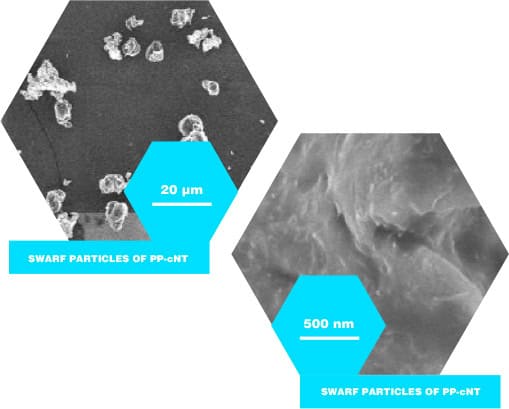
Figure 7. Swarf particles of PP-CNT polymeric matrix obtained after abrasion. 1) 20 µm. 2) 500 nm.
Overall, the exposure to NC7000™ can be considered as negligible as soon as the material is embedded in a polymeric matrix.
Working safely with Nanocyl products
From research and development through production, packaging, distribution, storage, use and disposal, Nanocyl Product Stewardship activities are designed to minimize risks throughout the life-cycle of its products. Nanocyl established strict safety rules for worker safety and Carbon Nanotubes production. Risk evaluation will be different if you are an industrial customer handling NC7000™ powder or Nanocyl® formulated products.
In line with the hierarchy in the Chemical Agents Directive (the reduce-to-a minimum principle -article 6 of Chemical Agents Directive 98/24/EC), various risk management measures (RMM) can be implemented in order to minimize the exposure to NC7000™ at occupational level.
NC7000™ is produced in closed processes and the highest likelihood for release of NC7000™ is during the manufacturing and the handling of powder in industrial plants. Protection measures are in place to minimize as much as possible the potential exposure to NC7000™ dust, including engineering controls (e.g. butterfly valve system), automated reactors and personal safety equipment (e.g. FFP3, appropriate gloves), cleaning methodology according to existing guidance documents. The concentration of NC7000™ in the air is regularly measured to be below the Nanocyl internal occupational exposure limit. This value is derived from a Low Observed Adverse Effect Concentration (LOAEC) of 0.1 mg/m³ from 90-day inhalation study (Ma-Hock et al. 2009). Nanocyl chooses to apply a very conservative safety factor of 40 in order to derive an internal Occupational Exposure Level (OEL) of 2.5μg/m³.
Risk evaluation will be different if you are an industrial customer handling NC7000™ powder or Nanocyl® formulated products:
- Handling of Plasticyl™, Elastocyl™ and Aquacyl™
- Handling of Epocyl™ and Orgacyl™
- Handling of NC7000™ powder
Details of packaging of products are available in the TDS and the other detailed handling recommendation in the MSDS (see products).
Nanocyl handling recommendations for NC7000™ multiwall carbon nanotubes are summarized in this section.
| Transport
|
No specific handling for the transport of NC7000™. |
| Packaging
|
The standard industrial packaging of NC7000™ powder is a cardboard containing a transparent plastic bag sealed with hose clamps (2,5 kg).
It is possible to request on demand for first trials a 500 gr plastic bottle with a cap (special R&D packaging). |
| Protection equipment
|
It is recommended to wear gloves, googles, FFP3 mask and protective clothes before using NC7000™ in powder.
It is also recommended to use butterfly valves to integrate NC7000™ into the polymers (See the category HSE in Case Studies module) |
| Storage Stability
|
NC7000™ is chemically inert to a large extent and shows no chemical changes after long periods of storage when stored under suitable conditions. Due to high specific surface, volatile substances may be adsorbed on the NC7000™ surface. Prolonged periods of storage may cause the NC7000™ products to become slightly compacted. This can lead to a minimal rise in the density, which might slightly affect correlated product properties. |
| Waste Management
|
In case of powder spills, use a vacuum cleaner equipped with a HEPA filter (H14).
Nanocyl recommends to burn scraps or collected materials of the materials. Burning of materials is also recommended if you want to get rid of the material. |





Additional details of NC7000™ packaging or technical information are available in the technical data sheet (TDS).
Additional details of NC7000™ handling recommendations are available in the material safety data sheet (MSDS).
Detailed handling recommendations guidelines or risk management measures with NC7000™ are available on request. Do not hesitate to talk to an Expert.
Nanocyl handling recommendations for polymer masterbatches and water dispersions are summarized in this section.
| Transport
|
No specific handling for the transport of Plasticyl™, Elastocyl™ and Aquacyl™. |
| Packaging
|
Plasticyl™ and Elastocyl™ products are provided in cardboard containing a sealed transparent plastic bag or in white plastic bags (20-25 kg).
Aquacyl™ products are provided in black plastic jerry with a cap (from 5 up to 1000 liters). |
| Protection equipment
|
It is recommended to wear gloves and protective clothes if not already mandatory on your manufacturing site before using PLASTICYL™, ELASTOCYL™ or AQUACYL™ products.
Use the product directly or dilute it with appropriate dispersion equipment such as twin screw extruders for PLASTICYL™. |
| Storage Stability
|
PLASTICYL™ and ELASTOCYL™: No chemical changes after long periods of storage (> 6 months) if stored under suitable conditions (dry and dark).
AQUACYL™: Max 6 months. After 6 months, CNTs aggregation/sedimentation could occur. Keep above 0°C. Do not freeze. |
| Waste Management
|
In case of spills of PLASTICYL™ or ELASTOCYL™, vacuum.
Nanocyl recommends to burn scraps or collected materials by vacuum. In case of leaks of AQUACYL™, clean with absorbent paper or linen rag. Nanocyl recommends burning contaminated rags. Burning of materials (PLASTICYL™, ELASTOCYL™ and AQUACYL™) is also recommended if you want to get rid of the material. |
Additional details of Plasticyl™, Elastocyl™ and Aquacyl™ packaging or technical information are available in the associated technical data sheet (TDS).
Additional details of Plasticyl™, Elastocyl™ and Aquacyl™ handling recommendations are available in the material safety data sheet (MSDS).
Available data showed that converters and consumers can use safely applications based on our formulated products.
This statement of the global risk assessment of Nanocyl® formulated products is based on the data generated in hazard and exposure studies.
From those studies, Nanocyl has put in place safe handling recommendations for the use of formulated products. This is particularly interesting for converters such as injection molders.
Available data showed that converters and consumers can use safely applications based on our formulated products.
- Based on hazard assessment on our formulated products, it has been possible to conclude that no additional toxicity was found with polymeric matrices containing NC7000™ compared to raw polymeric matrices.
- Exposure: Fragments of degraded matrix with embedded or surface network NC7000™ are generated by applying mechanical or ageing stress to a polymeric matrix containing NC7000™. Consumers and converters are therefore not exposed to carbon nanotubes (free or agglomerates).
Hazard of formulated products
During the use of articles made of formulated products containing NC7000™, the host matrix could be degraded (abrasion, weathering, etc.) releasing microsized particles. In any case, NC7000™ apparently remains encapsulated inside the matrixes (see section Exposure of formulated product). Moreover, physiological lung effects of the abraded materials containing or not the NC7000™ (either in vivo or in vitro) were assessed. Results demonstrate that there is no additional lung toxicity with the material containing NC7000™ [Wohlleben et al. 20113; Woh
Nanocyl handling recommendations for epoxy resins concentrates and solvent dispersions are summarized in this section.
| Transport
|
Matrices used to manufacture EPOCYL™ or ORGACYL™ range of products are considered to be potentially dangerous.
Transport of EPOCYL™ is therefore falling under the “European Agreement concerning the International Carriage of Dangerous Goods by Road (ADR)”. This requires a more specific packaging. Nanocyl doesn’t allow EXW purchases for EPOCYL™ products. Nanocyl will choose the carrier to avoid any risks and to ensure a short delivery time. |
| Packaging
|
EPOCYL™ products are provided in sealed plastic drum containing a metallic drum (25 kg) and vermiculite.
ORGACYL™ products are provided in plastic canisters. |
| Protection equipment
|
It is recommended to wear gloves, googles, dust masks and protective clothes if not already mandatory on your manufacturing site before using EPOCYL™ or ORGACYL™ products.
Use the product directly or dilute it with appropriate dispersion equipment such as 3-roll mill for EPOCYL™. |
| Storage Stability
|
EPOCYL™ and ORGACYL™: No chemical changes after long periods of storage (> 6 months) if stored under suitable conditions (dry and dark). |
| Waste Management
|
In case of leaks of EPOCYL™ or ORGACYL™, clean first with dry absorbent paper or linen rag. Secondly, clean with absorbent paper or linen rag containing appropriate solvent (depending on the nature of the raw material: type of epoxy, NMP). Nanocyl recommends burning contaminated rags.
Burning of materials (EPOCYL™ and ORGACYL™) is also recommended if you want to get rid of the material. |
The Regulatory Framework
Based on a life cycle approach, the development of products is subject to regulatory control at every stage. The European chemical industry is well regulated, with the European Union legal framework for chemicals recognized as one of the most advanced worldwide. However, nanomaterials raise a number of safety and regulatory questions. Nanocyl did not wait government focus and is committed to the safe and sustainable development of NC7000™ and NC7000™ formulated products by generating safety knowledge. By sharing those results with authorities Nanocyl contributes to development of specific regulatory framework.
Nanocyl is active in the follow up of new regulatory developments related to product safety.
Although there are no explicit requirements for nanomaterials under REACH (Registration, Evaluation, Authorisation and restriction of Chemicals) or CLP (Classification Labeling and Packaging), they meet the regulations’ substance definition and therefore the provisions apply. In 2011, the European Commission released a specific recommendation on the definition of a nanomaterial. The recommendation should be used in different European regulations, including REACH and CLP.
Like the EU, most of the industrial countries have put systems in place to register chemical substances and to require toxicological and eco-toxicological data before authorizing the marketing of substances on their territory. Worldwide, the requirements are similar to those of REACH in Europe and dossier should be submitted and analyzed by the authorities in order to get the authorization. The main difference compare to EU is the fact that each company should submit a dossier while in the EU joint submission is recommended.
Nanocyl is active in the follow up of new regulatory developments related to product safety. These can be those resulting from the REACH (Registration, Evaluation, Authorisation and restriction of Chemicals) regulation or CLP (Classification Labeling and Packaging) in Europe. Nanocyl is committed to comply with EU-REACH, the US-TSCA (Toxic Substances Control Act), the Canada-CEPA (Canadian Environmental Protection Act) regulations requirements and any other countries regulations where we plan to do business.



Specific regulatory dossiers were established based on data generated on our NC7000™. For all dossiers no specific CAS number was provided to the authorities and our product was registered under the chemical name “short tangled multi-walled carbon nanotubes obtained by chemical vapour deposition”. The following registrations numbers were obtained worldwide:
- EUROPE: REACH registration number : 01-2119879048-26-0001
- US: PMN (Pre-Manufacture Notice) registration number: P09-0417
- CANADA: NSN (New Substance Notification) Schedule 5 – registration number : 16037
To ensure access to prime state-of-the-art information on our product in the field, we are adopting a very open and collaborative attitude notably through several international collaborations with various stakeholders:
- Academics and research centers: scientific experts by collaborating inside collaborative funded projects (e.g. FP-7, H2020 programs,…)
- Authorities: US-EPA, Environment & Health Canada,…
- Industrial Associations: CEFIC, FEB, NIA…
Sustainability
Human population and its associated needs are continuously growing even as a faster rate since the beginning of the 20th Century. Quality of life has also mostly increased almost everywhere in the world at different speeds. This brings a huge pressure on all types of resources (agricultural, metals, raw materials, etc.). One way to compensate higher demands in resources is to provide more long-lasting materials.
NC7000™ carbon nanotubes and NC7000™ formulated products push materials to new limits of performances allowing new more sustainable products to emerge. Use of carbon nanotubes contribute indirectly to:
Save use of raw materials and energy (durability)
NC7000™ extends the creep/fatigue resistance of the material (particularly in thermosets) contributing to lengthen the life of the product. For example, a truck tire will last 80.000 km instead of 40.000 km. The rubber material is therefore more efficiently used and contributing to a lower impact on environment (less waste, etc.).
Reduce CO2 emissions
NC7000™ induces in many applications a CO2 reduction following different patterns:
- Weight reduction of the component (especially in transport industries). NC7000™ improves mechanical performances of structural composites pushing the replacement of metals by those lightweight materials. NC7000™ brings electrical conductivity to thermoplastics pushing as well the replacements of metal parts which are much heavier (e.g. automotive fuel lines, etc.).
- Improvement of current energy storage. NC7000™ is used to improve Li-ion batteries, flow batteries and other energy recovery systems. This in return allows to store more energy from the renewable energy production systems (such as wind mills, solar panels, etc.) and flatten the non-continuous renewable energy production allowing to slip away slightly from coil and gas energy production.
- Future energy harvesters. NC7000™ is used in the development of affordable and flexible thermoelectric/piezoelectric devices, organic solar cells and heating fluids for solar panels.
Replace toxic compounds
- NC7000™ and combination with other non-halogenated flame retardants allows the creation of halogen-free materials with multifunctional properties (flame retardancy, electrical conductivity, better mechanical properties).
- BIOCYL™ is an eco-friendly easy fouling release system used in underwater coating applications, such as ship hulls, oil rigs, and underwater intake valves. The fouling protection does not come from the toxicity of the coating, but from the BIOCYL™ nanostructuring of top coating surface in interaction with the silicone material.
Nanocyl is active in the follow up of new regulatory developments related to product safety. These can be those resulting from the REACH (Registration, Evaluation, Authorisation and restriction of Chemicals) regulation or CLP (Classification Labeling and Packaging) in Europe. Nanocyl is committed to comply with EU-REACH, the US-TSCA (Toxic Substances Control Act), the Canada-CEPA (Canadian Environmental Protection Act) regulations requirements and any other countries regulations where we plan to do business.
Specific regulatory dossiers were established based on data generated on our NC7000™. For all dossiers no specific CAS number was provided to the authorities and our product was registered under the chemical name “short tangled multi-walled carbon nanotubes obtained by chemical vapour deposition”. The following registrations numbers were obtained worldwide:
- EUROPE: REACH registration number : 01-2119879048-26-0001
- US: PMN (Pre-Manufacture Notice) registration number: P09-0417
- CANADA: NSN (New Substance Notification) Schedule 5 – registration number : 16037
To ensure access to prime state-of-the-art information on our product in the field, we are adopting a very open and collaborative attitude notably through several international collaborations with various stakeholders:
- Academics and research centers: scientific experts by collaborating inside collaborative funded projects (e.g. FP-7, H2020 programs,…)
- Authorities: US-EPA, Environment & Health Canada,…
- Industrial Associations: CEFIC, FEB, NIA…