




BIRLA CARBON BLOG
INSIDER KNOWLEDGE FOR ALL THINGS CARBON BLACK
Characterization of Continua™ SCM – Agglomerate Size
Reading Time: 1.5 minutes
Introduction
In part 2 of this series of blogs we described the key parameters that drive the performance of the Sustainable Carbonaceous Material (SCM) created through the pyrolysis of end of life rubber articles in applications.
These have been identified as:
- Carbonaceous residue
- Bound agglomerate size
- Ash Content
- Transmittance
In this blog we will cover Bound Agglomerate Size in more detail.
What Are Bound Agglomerates
A bound agglomerate is the smallest dispersible unit of SCM and contains a blend of carbon black, silica and other inorganic impurities. Although more commonly known as ‘particles’, the term ‘bound agglomerate was adopted by ASTM committee D36 in D8178 to avoid confusion with carbon black particles. Figure 1 shows a comparison of sub-micron carbon black aggregates and micron scale SCM bound agglomerates where the different length scales can be clearly seen.
Measurement of Agglomerate Size
Many methods are available for measuring the size of powders but work by Birla Carbon and others[1],[2] have identified that dry laser diffraction methods offer the best method of measuring SCM agglomerate size. This method uses the scattering of laser light to calculate the equivalent diameter of the material passing through the detector. The distribution of the sizes can then be reported, with D97 (the size covering 97% of the measured agglomerates) recommended for materials below 20µm.
This test method is in the process of being adopted by ASTM D36 rCB Committee.

Effect of Agglomerate Size on Application Performance
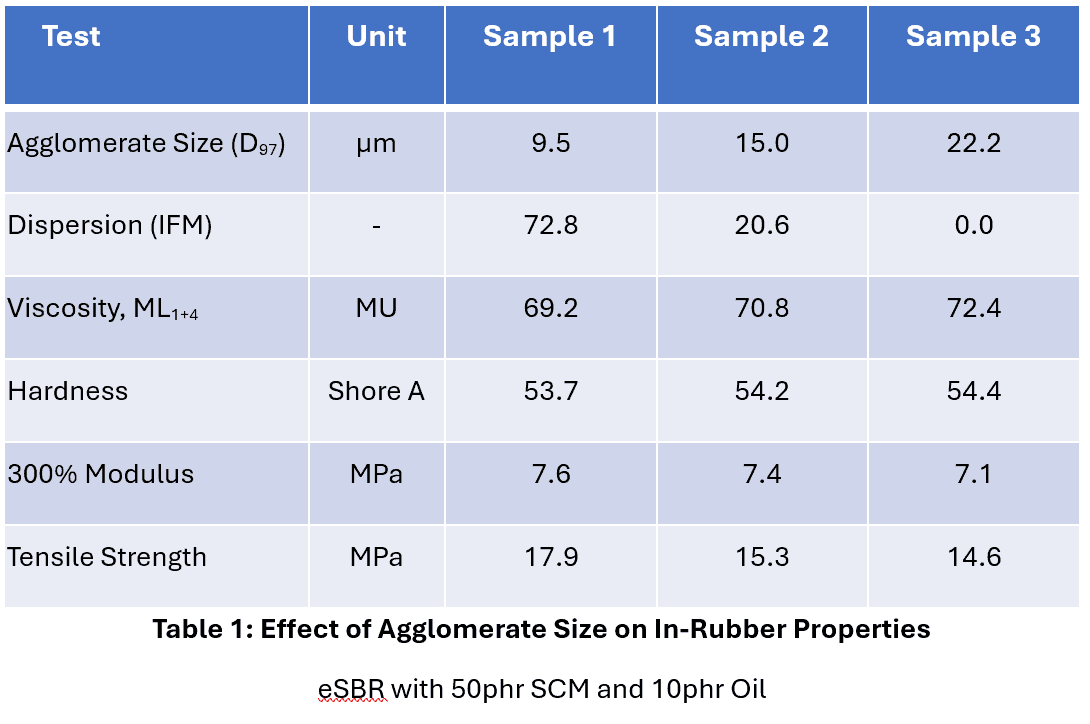
Table 1 below shows the effect of agglomerate size on the reinforcement of the same char milled to different agglomerate sizes.
Conclusions
Bound Agglomerate size is one of the critical parameters affecting the performance of SCM. Controlled by milling, this parameter affects the reinforcement of the material in rubber applications. The recommended method for measuring this parameter is dry particle size analysis using laser diffraction.

Dr. Joseph Hallett
Dr Hallett has worked in the rubber industry for over 25 years in a number of roles including product design and development, laboratory management, quality, and customer support. He re-joined Birla Carbon in 2019 and in total has worked in the carbon black industry for over 18 years. His current role is the Technical Lead for Birla Carbon’s circular product, Continua™ SCM and was part of the introduction team during the products development. Dr Hallett has a Bachelors Degree in Engineering and his PhD looked at the effect of load case on the performance of rubber compounds.
WANT TO LEARN MORE ABOUT CARBON BLACK AND THE PROPERTIES THAT MAKE IT IDEAL FOR YOUR PLASTICS, COATINGS, AND INKS APPLICATIONS?



Leave A Comment