




Environment
Advancing Industry Standards: Carbon Black LCA and Product Carbon Footprint
Birla Carbon is an active member of the International Carbon Black Association (ICBA). The ICBA is a scientific, non-profit corporation founded in 1977 that is dedicated to advancing research on the health, safety, and environmental aspects of carbon black production and use. Furnace carbon black (CB) represents 95% of the volume manufactured by ICBA members and is the main processing technology used on the market. The release of an average cradle-to-gate PCF for furnace carbon black marks a significant step forward in the association’s commitment to support downstream industries in meeting their sustainability and decarbonization goals, as well as eco-design efforts. Through this initiative, the ICBA aims to provide a reliable, science-based reference point for customers’ PCF calculations, promoting consistency and transparency in sustainability reporting across the value chain.
The ICBA launched a collaborative initiative in 2024 to develop a Product Category Rule (PCR) for carbon black. This PCR will be designed to standardize how LCAs are performed across the carbon black industry. Standardization is important because the assumptions and boundaries set during LCA modeling can greatly impact the LCA results and conclusions. By creating this PCR, the ICBA aims to make product-level LCA and PCF data more credible and comparable across the industry.

Carbon Black LCA Leadership
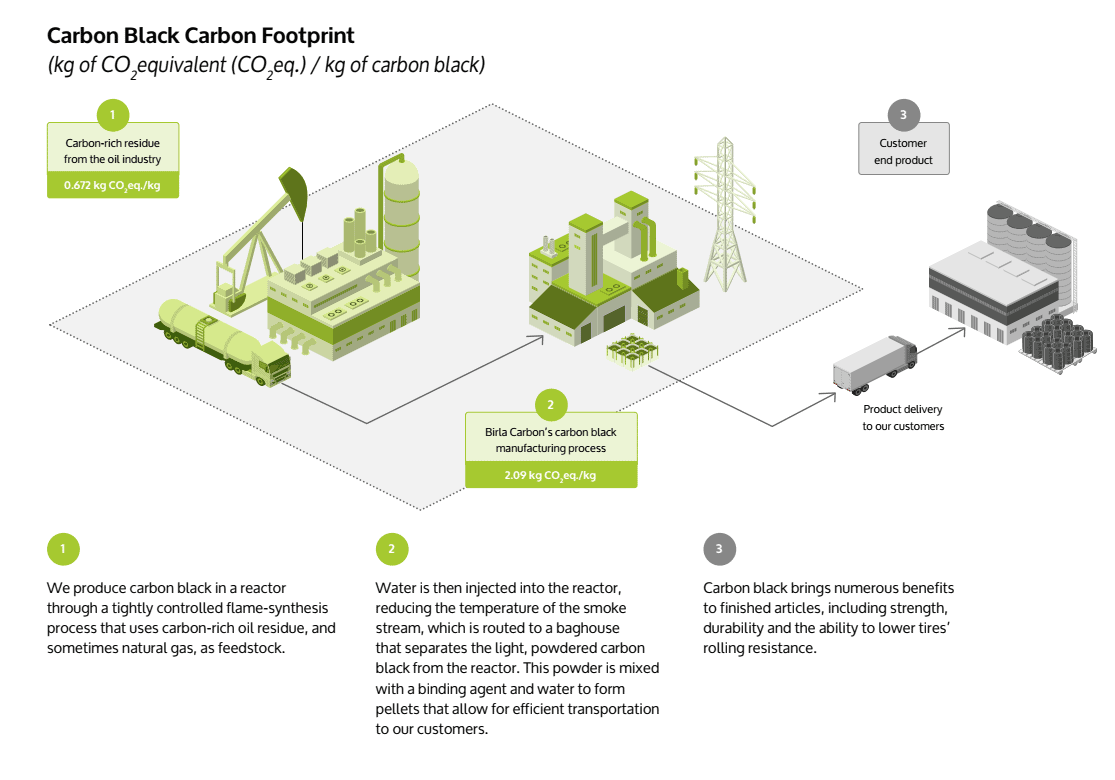
Our FY2024 cradle-to-gate LCA study was conducted in accordance with ISO14040 and ISO14044 and verified by an independent third-party reviewer. We recognize the importance of collaborating with our stakeholders to address their overall carbon footprint mitigation strategies. In line with our commitment to sustainability and transparency, we publicly shared the results of our LCA on our website. This practice fosters trust and ensures open communication with our stakeholders, providing them with clear insights into Birla Carbon’s LCA carbon footprints.
Insights from our LCA support credible environmental claims and informed decision-making. By conducting LCAs, Birla Carbon gains actionable insights to enhance sustainability performance and actively contribute to broader industry discussions. These insights are also being woven into our business planning, ensuring that sustainability considerations shape both strategic and operational decisions.
Continua™ SCM LCA
Our Continua™ Sustainable Carbonaceous Material (SCM) is a breakthrough innovation designed to drive circularity at scale. This material not only enhances the recyclability of end-use tire products but also delivers quantifiable life cycle benefits. According to our LCA results, Continua™ SCM offsets approximately 0.73 kg of CO2eq. for every 1 kg of Continua™ produced based on a system expansion modeling approach. By offering a high-quality circular alternative to conventional carbonaceous materials, Continua™ SCM empowers our customers to significantly reduce their GHG emissions and move toward more sustainable production practices.
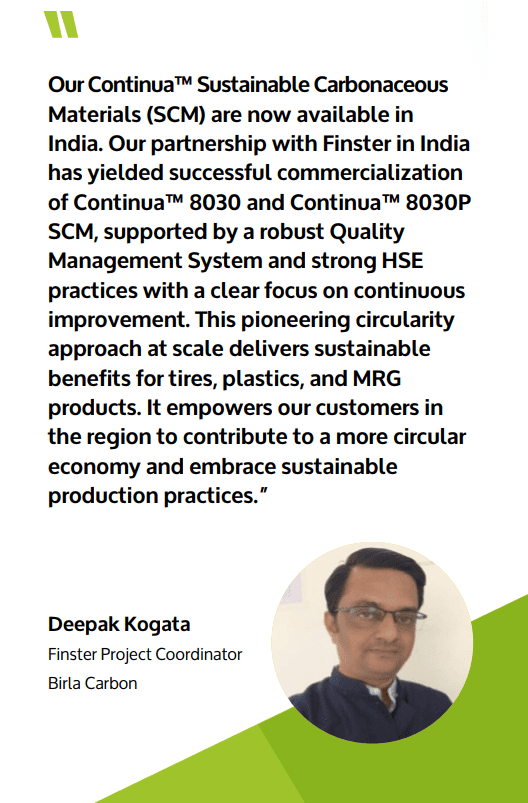
In October 2024, we expanded our production of Continua™ SCM to India through our partnership with Finster. We have since launched and successfully commercialized two grades; Continua™ 8030 and Continua™ 8030P SCM. Our collaboration with Finster has been instrumental in upgrading our tire recycling facility, and we expect to begin expanding capacity at the facility in mid-2026. In partnership with Finster, we have implemented robust Operational Excellence practices across production, Health, Safety, and Environment (HSE), and our Quality Management System (QMS). We plan to update our LCA during FY2026 to account for these expansions and process improvements.

Circularity
Continua™ SCM is a unique family of products that enables circularity at scale by developing the next generation of sustainable solutions for tires, mechanical rubber goods, plastics, and coatings industries. It provides performance-enhancing benefits by boosting product longevity and can replace virgin carbon black in selected applications, thereby reducing greenhouse gas emissions and diverting end-of-life materials from going to landfill.

GHG Reduction
Our approach to carbon stewardship extends throughout our entire value chain, from raw material extraction to manufacturing, product delivery, and product end-of-life. We are committed to reducing our carbon footprint at every stage, and to embedding circularity into our operations. This commitment supports our goal of achieving netzero carbon emissions by 2050 while also reducing waste, water, and energy consumption.
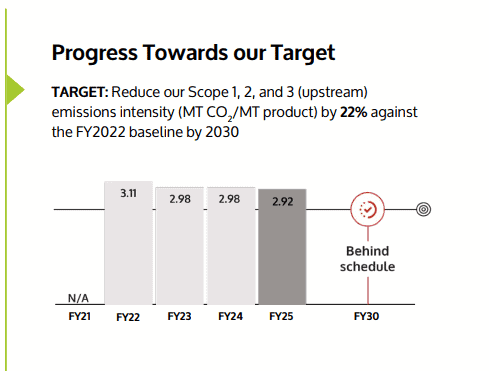
To guide our greenhouse gas emission reduction efforts, we have established an interim target to reduce our Scope 1, 2, and 3 (upstream) emissions intensity (Mt CO2 /Mt product) by 22% against our FY2022 baseline by 2030. We developed this interim target by utilizing our robust and verified GHG inventory, findings from our LCAs, and our netzero roadmap. This updated target reflects our life cycle approach and commitment not only to consider GHG reduction within our plants, but throughout our value chain as well.

Our Net-Zero Roadmap
Our strategy for reducing our GHG emissions to achieve net zero remains anchored by the 4Rs: Reduce, Replace, Repurpose, and Research. Targeting a reduction in emissions over the coming decades, we will focus on decarbonizing our business and reducing our emissions from our production levels. Achieving this requires industry collaboration, so we are engaging experts and creating long-term partnerships to reach our goal.

Reduce (8%)
Decreasing dependence on traditional processes in manufacturing. Our emphasis is on developing process efficiencies in carbon black production and prioritizing energy efficiencies throughout our operations.
Replace (6%)
Substituting with alternative energy and feedstock. Some Birla Carbon locations have introduced renewable energy sources to power parts of their facility. Our focus moving forward will be on adding renewable energy solutions. In addition, Birla Carbon recently completed four production trials with recycled and bio-derived feedstocks, a contributor to our net-zero roadmap.
Repurpose (6%)
Determining carbon solutions for sustainability through circularity. Through our Continua™ product line, Birla Carbon leads the industry on sustainability and circularity programs at scale — enabling our customers to develop the next generation of sustainable products.
Research (80%)
Innovating our existing processes and looking for new ways to capture and convert carbon. A large part of Birla Carbon’s net zero success will come from enablement by future technologies that will capture and convert carbon dioxide into valuable carbon products. Our business focuses on investments in and the development of such technologies.
Sustainable Packaging with Recycled Content
As part of our commitment to reducing environmental impact and promoting circularity in our operations, Birla Carbon, Italy has undertaken a targeted initiative to increase the recycled content in our packaging materials. This initiative focuses on incorporating a minimum percentage of recycled plastic into various packaging formats, reducing reliance on virgin materials and extending the life cycle of resources.
- Big bags with 30% recycled plastic from recovered big bags
- Protective covers made with recycled plastic
- Regenerated or second-life pallets extending their usable life and minimizing waste
- Wrapping film with 60% recycled plastic
- Small bags with 30% recycled material (currently in the testing phase to ensure performance and quality standards are met)
This initiative by Birla Carbon not only supports waste reduction and resource efficiency but also aligns with our broader sustainability
strategy fostering a closed-loop system across our value chain.
Water
Birla Carbon’s water strategy considers short, medium, and long-term scenarios to improve and mitigate water risks at our facilities. We have integrated a water risk management approach into our wider Enterprise Risk Management (ERM) strategy and identified the high-risk sites. The high-risk sites are now incorporating water resource management planning (WRMP) into their business continuity plans. We strive to minimize our use of fresh and groundwater by seeking opportunities to recycle and reuse whenever possible.

Waste
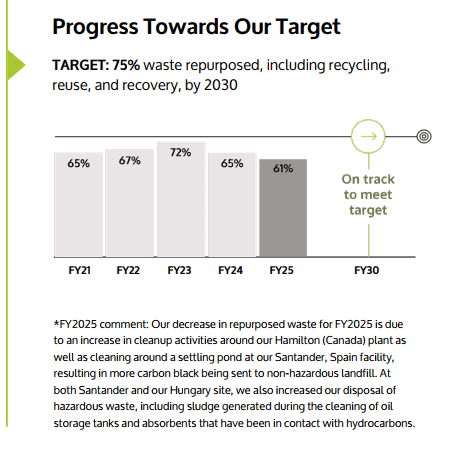
Management and minimization of waste is a priority for all Birla Carbon manufacturing sites and offices. Despite the relatively small quantities involved, our industrial processes generate waste, and we are committed to enhancing the circularity within our operations.
Our strategy focuses on reducing waste generation and ensuring that any waste we produce is reused or recycled, whether for the same or
a secondary purpose. We adhere to all relevant HSE requirements and ensure waste materials are disposed of in the safest and most sustainable manner possible
Air Emissions
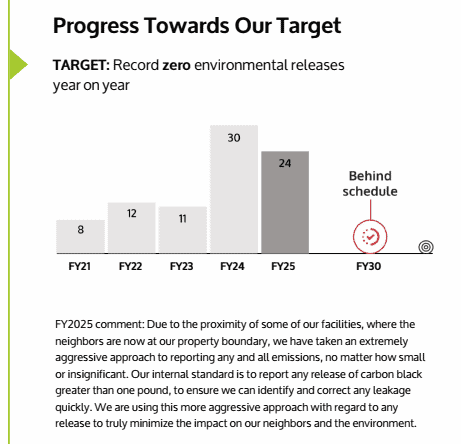
We are dedicated to minimizing non-GHG air emissions from our manufacturing processes and business operations. Through our commitment to the Share the Future strategy, we continually seek out the best processes and technologies to reduce these emissions. We monitor our air emissions closely to ensure compliance with local regulations wherever we operate. Additionally, we have established policies and procedures to promptly notify local authorities and take necessary actions if emission thresholds are exceeded.